
Floyd Rose Tremolos for Left-Handed Guitars: Licensed Versions

Updated: 7 days ago
The following series is the definitive guide on Floyd Rose tremolos (and variants) with a special (but not exclusive) emphasis on left-handed guitars. It covers genuine, licensed, and proprietary systems, both historical and current. Nowhere else on the internet will you find all this information in the one place.
This series is in five parts:
Part 1: Original and Genuine Floyd Rose (Floyd Rose, Fernandes, Schaller, Sung-il, Ping Well)
Part 2: Licensed Versions (Schaller, Kahler, Gotoh, Takeuchi, Ping Well, Jin Ah)
Part 3: Proprietary Versions (Fernandes, St. Louis Music, Aria Pro II, Jin Ah, Ibanez, Yamaha, ESP, Kahler, Jackson-Charvel, Kaman Music Corporation)
Part 4: The Asian OEM Pool ("Korean Catalog", "Chinese Catalog")
Part 5: No-Names, Fakes, Unknowns, and Never Left-Handed
Introduction: An OEM (Original Equipment Manufacturer) is a company that produces components or complete products for another brand. In the 1980s, Floyd Rose licensed multiple manufacturers to produce his patented double‑locking tremolo system, with variations sufficient to distinguish them from the original product. Note: Only the Original Floyd Rose (OFR) tremolo and later low‑profile Floyd Rose Pro were licensed in this way. The Non‑Fine Tuner (NFT) tremolo was always produced as a genuine Floyd Rose product.
This guide focuses on OEMs that manufactured licensed versions of the Original Floyd Rose for supply to specific guitar brands and as aftermarket kits. This is distinct from those that produced the genuine article and from those that produced derivative designs, whether additionally licensed or not. Some manufacturers produced genuine products, licensed versions, and proprietary designs, so they appear in multiple sections where relevant. Note. The term "licensed" is now a historic term applicable only to the period before the patents expired in the 2000s.
Author's note: At the end of the introductory history section in Part 1 of this series, I said that Takeuchi and Gotoh could be viewed as “coming to our rescue” when it came to left-handed Floyd Rose-style tremolos. Part 2 is where that claim really comes into its own: while Floyd Rose itself so often failed to provide left-handed versions, these two Japanese manufacturers repeatedly did. Korean OEM Jin Ah probably deserves an “honourable mention” too. Sadly, of these three, only Gotoh is still in business today.
Schaller
Schaller Licensed Tremolo
Years: 1984–2012 | Made in: Germany | Status: Discontinued
In addition to manufacturing the genuine Original Floyd Rose (OFR) tremolo and both versions of the Floyd Rose II, Schaller also produced its own licensed tremolo. Like other licensed versions, the Schaller Licensed Tremolo (SLT) used a zinc-alloy baseplate rather than the hardened-steel construction of the genuine Original Floyd Rose. Other than this, the SLT is almost identical to the OFR. Schaller sold it directly to the public as an aftermarket option and supplied it as an OEM product. In Japan, several guitar brands, including Fernandes, Caparison, and Kawai/Rockoon, referred to it as the “S-FRT-II.”
There are some manufacturing and dimensional differences:
The baseplate of the SLT is zinc cast, as opposed to being hardened steel on the OFR.
The fulcrum points on the SLT have replaceable hardened steel inserts.
The locking screws on the SLT are shorter, thus allowing the unit to fit in a smaller rout.
The SLT features a 12" radius, as opposed to the 10" radius of the OFR.
The Schaller Licensed Tremolo had "Schaller" embossed on one side of the baseplate and "Made in Germany by Schaller" embossed on the other. The sustain block was cast with U.S. patent numbers 4,549,461 and 4,497,236, along with the block size. OEM-supplied units could be engraved with the relevant brand name or model designation. Several guitar brands incorporated the Schaller Licensed Tremolo into select production models, including Jackson Stars, B.C. Rich, Charvel, Fender, Grover Jackson, Squier, Hamer, Washburn, and Fernandes.
Schaller phased out left-handed units in 2012.
Left-handed Schaller Licensed Tremolo Left-handed Schaller Licensed Tremolo Left-handed Schaller Licensed Tremolo Left-handed Schaller Licensed Tremolo
Documented left-handed guitars equipped with the Schaller Licensed Tremolo include:
Grover Jackson: 1996/1997 Japan-only RR/L.D-144 and SL/L.D-138,
Hamer: 1995 USA-made Diablo,
Charvel: USA-made 1989 Deluxe 475.
Fernandes: 2003 Hisashi Imai "Stabilizer" Signature (long-running model but only offered left-handed for one year.)
Caparison: 2012 Dellinger WM, Dellinger-II WM, Dellinger M3, and Dellinger-II WM.
NOTE: New, high-quality unbranded left-handed SLT aftermarket replacements can be bought here: Gaskell Guitars Retail | Reverb Australia
2005 Jackson Stars catalog featuring left-handed models ars catalog featuring left-handed models 2005 Jackson Stars catalog featuring left-handed models 2003 Fernandes Hisashi Imai "Stabilizer" signature guitar - avaliable left-handed in 2003 only
LockMeister 6
Years: 2012– present | Made in: Germany | Status: Current
The Schaller LockMeister® 6 Tremolo is a further development of the Schaller Licensed Tremolo, using newer manufacturing methods. It is made in Germany and sold primarily as an aftermarket kit, with some OEM supply applications rather than widely documented factory installations. It can be bought through a music outlet or through Schaller directly if you are a manufacturer.
Like the Original Floyd Rose, the baseplate is made of hardened steel. All studs, inserts, and screws are black zinc and black chrome finished. It has height-adjustable, one-piece string saddles for a 12" tremolo radius, eliminating the need for shims. The fine tuner screws also have longer threads. Earlier versions were engraved with "Schaller" on the baseplate and the block size cast into the sustain block. The tremolo was updated in 2023 to allow different radii. At the same time, the baseplate inscription changed to "LOCKMEISTER." Longer fine tuners were added in 2025.
The LockMeister is a direct replacement for the Original Floyd Rose but not for the earlier Schaller Licensed Tremolo (which requires a shorter rout.) Left hand models are available in Chrome, Satin Chrome, Black, Gold, Nickel, and Ruthenium.
Left-handed Schaller LockMeister Left-handed Schaller LockMeister Left-handed Schaller LockMeister Left-handed Schaller LockMeister
Kahler
In the 1970s, Gary Kahler produced brass guitar parts and hardware for Fender and later DiMarzio. Kahler subsequently established American Precision Metal Works (APMW), and in 1981 introduced a guitar bridge system that would evolve into his famous cam-based tremolo design. This system differed fundamentally from the fulcrum-based double-locking tremolo developed by Floyd Rose. Kahler's products have historically been manufactured in the USA.
In 1986, Kramer brought patent-infringement claims against Gary Kahler's American Precision Metal Works (APMW) in connection with Floyd Rose's tremolo patents. The dispute was settled in 1987, creating a business relationship in which APMW manufactured tremolos, under license.
Kahler introduced three double-locking, fulcrum-style tremolos: the Steeler, a Floyd Rose-based licensed design, and the Spyder and Killer, which incorporated Kahler's own design features alongside Floyd Rose elements. Period Kahler documentation identifies the 2710 Killer, 2720 Spyder and 2760 Steeler in its fulcrum-tremolo range by 1989. Left-handed versions were produced. APMW also manufactured the Floyd Rose Pro for Kramer and Rose. (For information on the Floyd Rose Pro, see Part 5: No-Names, Fakes, Unknowns, and Never Left-Handed.)
In 1992, Floyd Rose again filed a patent-infringement lawsuit against Gary Kahler and American Precision Metal Works (Case No. 8:92-cv-00166, Central District of California). According to a subsequent federal court account, Rose's 1992 lawsuit resulted in APMW's exit from the tremolo market. The same court record states that Kramer's 1989 bankruptcy and default on purchase obligations to APMW contributed to APMW's failure to satisfy its licensing payments to Rose.
Following APMW's withdrawal from the tremolo business, Gary Kahler subsequently moved his focus away from guitar hardware and into golf and sporting goods. (Note: The Kahler Killer, Spyder, and reintroduced 2024 Steeler are covered in Part 3 of this series: Proprietary Versions.)
2760 Steeler
Years: 1989–1992 | Made in: USA | Status: Discontinued
The Kahler Steeler from the 1980s was Kahler's licensed version of the Original Floyd Rose double-locking tremolo. It was cast at the top of the baseplate with "Kahler - Made in USA Lic. Under Floyd Rose Pats" and cast at the bottom with "Made in USA by Kahler." Unfortunately, Kahler did not re-engineer the baseplates for left-handed use and instead used right-handed units fitted upside-down with a second hole drilled through the original stamping to accommodate the lefty tremolo arm. Despite the rough appearance, it did not affect the unit's functionality.
Carvin Guitars. During the 1980s, Carvin entered into an OEM arrangement with Kahler to source Kahler tremolos, including the Steeler, for its guitars. Carvin guitars were made-to-order and almost all models were available in left-hand. After Kahler left the industry in 1992, Carvin switched to Original Floyd Rose systems. The Steeler was used on the Carvin left-handed DC-150, the mid-1990s left-handed DC-135, the 1990 left-handed DC-300 Reverse Headstock, and on the 1992 left-handed DC-400. This 1991 left-handed X2200CL was ordered with a factory-installed Steeler.
B.C. Rich Guitars. U.S.-made B.C. Rich guitars from the late '80s were available with either a Kahler Steeler, a Kahler cam-based tremolo, or an Original Floyd Rose, depending on model. Left-handed examples include this USA B.C. Rich Warlock from 1988 fitted with a Kahler Steeler.
Tom Anderson Guitars. Tom Anderson Guitars used Kahler tremolos on some models during this period. This 1991 Tom Anderson lefty has a Kahler Steeler.
After more than three decades, Kahler reintroduced the Steeler in 2024 with engineering modifications and updates and is now a proprietary Kahler product. (See Part 3 of this series: Proprietary Versions.)
A Critical Note on new Left-Handed Steeler
Author's note: I bought a new lefty Steeler in 2025. The new Steelers are being produced using N.O.S baseplates from 30 years ago. The one I received was rusty and tarnished. I realize these are made of genuine American steel and the units have superior engineering, but this was a disappointment considering the premium price. Despite Kahler's best intentions, we couldn't get it up to scratch and sadly, I had to return it. The procedure they are using to make a lefty unit in 2025 is the same they used in the 1980s: put a regular RH baseplate on the drill press and drill a hole through the other side. The only problem is that because of the density of the steel, it is impossible to make a clean hole, and the hole goes through wording. If you are interested, see my review here: New lefty Kahler Steeler Review
1995 LH Carvin DC50 1990 LH Carvin DC300 1992 LH Carvin DC400 2025 Kahler Steeler lefty. Hole drilled through the base plate
Gotoh
Gotoh is a major Japanese parts manufacturer that has supplied guitar hardware for multiple guitar brands since 1960. Although no primary-source documentation has yet been identified, Gotoh may have been involved in manufacturing some original Floyd Rose prototype and early-model tremolos for Fernandes, who in turn supplied these to Floyd Rose in the United States before Schaller became the eventual manufacturer.
Gotoh manufactured licensed Floyd Rose tremolos and brand-specific systems for multiple brands, including Yamaha, Aria Pro II, and Ibanez. The company also produced its own Gotoh-branded double-locking Floyd Rose variant, which has remained largely unchanged since 1988. It is a popular aftermarket Floyd Rose alternative.
Gotoh's brand-specific and proprietary developments are covered in Part 3 of this series: Proprietary Versions
Edge Tremolo
Years: 1986–2004 | Made in: Japan | Status: Discontinued
Gotoh's own version of the Original Floyd Rose, manufactured under license from Floyd Rose, was its Edge Tremolo, released in 1986. Although the history presents something of a "chicken-and-the-egg" situation, the Edge may originally have been intended as a broader OEM product. This is suggested by factory-fitted examples found on Japanese-built B.C. Rich models from around 1986–87, despite the design supposedly being exclusive to Ibanez at the time and marketed as the Ibanez Edge.
The Edge is very close to the Original Floyd Rose design while incorporating several refinements, as described in Ibanez’s 1986 marketing materials:
“Several unique features set the IBANEZ EDGE apart from other tremolo systems. Fine tuners are located far to the rear of the unit, making right hand muting techniques possible without interference from the tuning knobs. The shape of the fine tuning knob is designed for maximum ease of operation. The tremolo arm itself snaps in and out quickly and will not become loose with heavy use. Steel sleeves hold each anchor bolt firmly in the body for solid sustain and stability. ... Licensed Under Floyd Rose Patents.”
The Edge was used by Ibanez for its upper-tier Japanese models and led to later Ibanez-specific tremolo developments in conjunction with Gotoh. The subsequent proprietary Edge Pro, Edge Pro II, Edge III, ZR, Edge Zero and related systems are covered in Part 3 of this series: Proprietary Versions
During its first year of use by Ibanez, the Edge was non-recessed then became fully recessed from 1987. It was cast with “Licensed Under Floyd Rose Patents” on the top of the tail. One side of the sustain block was cast with “Ibanez EDGE” and “JAPAN” in smaller lettering on a second line, and the other side was cast with the letters "HS" (meaning unknown.)
Left handed Ibanez Edge tremolo Left handed Ibanez Edge tremolo Left handed Ibanez Edge tremolo Left handed Ibanez Edge tremolo Left handed Ibanez Edge tremolo 1989 Ibanez Japan 540SL Lefty Ibanez Roadstar II with Edge Tremolo
The first left-handed Ibanez models to feature the new Edge Tremolo was the one-year-only 1986 PL1770L and the 1986–1987 Roadstar II RG440L. The Edge continued to be used on the 1988–1991 RG550L, the 1989–1990 Roadstar II 540S-L, the 1989–1992 RG560L, the 1993 USA and European market RG470L, the Japan-only 2001–2002 RGR580L, and the Europe-only 2002–2004 RG570L.
The original Edge was largely superseded by newer Ibanez tremolos from 2002 onward and was fully phased out by 2004.
1986 Ibanez catalog (English) 1986 Ibanez catalog (Japanese) 1986 Ibanez Roadstar Series
Note: During the 1980s Ibanez also used Takeuchi-made Floyd Rose-licensed tremolos on selected Japanese models, plus lower-cost Takeuchi copies sourced from the wider Asian OEM supply chain for its entry and intermediate level models not made in Japan. See following section on Takeuchi for the Ibanez "Lo-TRs" and Part 4 of this series: The Asian OEM Pool for the Lo-TRS II.
Ibanez Lo-Pro Edge
Years: 1991– 2003 | Status: Discontinued
Ibanez continued its collaboration with Gotoh and introduced a lower-profile version of the Edge Tremolo, called the Ibanez Lo-Pro Edge, in 1991. It is essentially a licensed version of the 1991 Original Floyd Rose PRO design (with short, stubby lock bolts inside of the tail), while incorporating the Gotoh/Ibanez characteristics carried over from the Edge. As with the Edge, it had "Licensed Under Floyd Rose Patents" cast on the tail, along with the same sustain block inscriptions.
By 1992, the Lo-Pro Edge had become the standard tremolo for all high-end Ibanez guitars made in Japan. The left-hand version is Ibanez Part No. 2LE1L31K.
From 1997, select high-end RG models previously fitted with the Lo-Pro Edge reverted to the original Edge.
Ibanez began phasing out the Lo-Pro Edge in the early 2000s in favour of its newer tremolo designs, and by 2003 it had disappeared from the catalogs.
Left-hand guitars built with the Lo-Pro Edge up until its discontinuation included the 1992 RG560L, the 1992 U.S. market RG570L, the 1992 RG550L, the very limited Japan-market 1995 RG570L, the 1998–2000 RG680CL, and the 2000 RG3120L.
Left handed Lo Pro Edge made by Gotoh Lefty Lo-Pro Edge Lefty Lo-Pro Edge Lefty Lo-Pro Edge Lefty Lo-Pro Edge Lefty Lo-Pro Edge Lefty Lo-Pro Edge Lefty Lo-Pro Edge
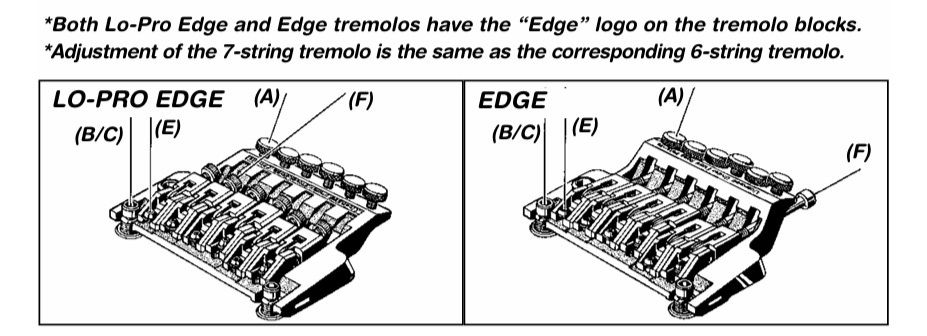
Reintroduced Edge and Lo-Pro Edge
Years: 2010– present | Status: Current
After discontinuing the Edge and Lo-Pro Edge in the 2000s and developing numerous proprietary tremolo systems and refinements thereafter, Ibanez reintroduced the original Edge and Lo-Pro Edge for its Japanese-made Prestige and Signature models in 2010. With the relevant original Floyd Rose patents having expired, current Edge and Lo-Pro Edge tremolos no longer carry, or require, Floyd Rose licensing statements. This does not alter their design lineage as continuation versions of the original Edge and Lo-Pro Edge designs. The sustain blocks of both current models retain the original “Ibanez EDGE” and “Japan” markings on the one side and "HS" on the opposite side.
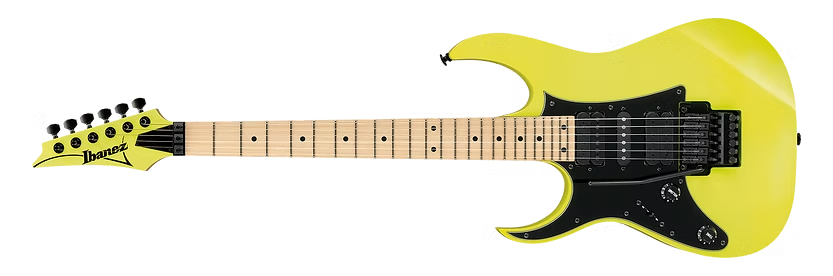
The reintroduced Edge tremolo was used on the following discontinued left-handed Prestige Series guitars: 2011-2013 JEM7VL Steve Vai Signature, 2011-2015 JS1200L Joe Satriani Signature, 2014 JS240L Joe Satriani Signature, 2016-2017 Prestige Series RG655L, 2016-2019 RG652AHML, 2017 30th Anniversary JEM777L, 2017 RG652MPBL, 2018 RGR652AHBL, and the 2018-2020 Genesis Collection RG550L reissue (available in Road Flare Red or Desert Sun Yellow.)
It is used on the current left-handed RG550L-DY (Desert Sun Yellow) Genesis Collection, since 2024. It is the only Ibanez guitar in the current lineup with the Edge tremolo.
The reintroduced Lo-Pro Edge tremolo was fitted to the 2020-2022 left-handed RG5320L.

As of 2026, only one Ibanez guitar is currently offered left-handed with the Lo-Pro Edge: the RG5120ML, since 2025.

Gotoh GE1988T
Years: 1988–1996 | Made in: Japan | Status: Superseded
With Ibanez having secured the Edge Tremolo for its own use in 1986, Gotoh introduced the GE1988T in 1988 as a broader OEM and aftermarket licensed Floyd Rose system.
The bridge was cast with "Licensed Under Floyd Rose Patents" on the tail, which was rear-facing, and "GOTOH Japan" on the sustain block. Later versions were engraved with "GOTOH" and the stylized "G" logo on the upper baseplate. It differs from the Original Floyd Rose in that the baseplate's top knife edge is straight (a trait shared with some earlier Fernandes and later Takeuchi and Jin Ah tremolos.) Also distinctive is that the saddle assemblies are bevelled, giving them a slightly rounded appearance. It has offset saddle screws so that the strings do not get in the way when adjusting the intonation. Its tremolo arm collar has a squared base. The GE1988T was sold as a retail boxed kit as well as an OEM product to guitar brands.
Gotoh GE1988T lefty Gotoh GE1988T Lefty Gotoh GE1988T lefty Gotoh GE1988T lefty
B.C Rich: From 1989 to 1992, B.C. Rich’s import production was predominantly Korean. The Japanese-made NJ Series II, however, was built by Teihatsu in Nagoya for Japanese and European markets only and were equipped with the Gotoh GE1988T. Right-handed units had "B.C. Rich" engraved upside down on their baseplate, while left-handed units usually had no inscription at all. The GE1988T was listed in B.C. Rich catalogs as the B.C. Custom Tremolo. Left-handed examples include this NJ Series Mockingbird, this 1990 Warlock WG-801LH, and this Japanese B.C Rich ST-III.
Lefty B.C Rich ST-III with Gotoh GE1988T Lefty B.C Rich ST-3 with Gotoh GE1988T 1990 B.C Rich Japan catalog Left handed B.C Rich OEM GE1988T (no logo)
Aria Pro II: Left-handed versions were never listed or mentioned in Aria Pro II catalogs and were obtainable only in dealer-initiated spot runs or as one-off special orders. Historically, Aria Pro II rebranded its OEM‑supplied bridges with its own product codes: “ACT” (Aria Concentric Tremolo) for non‑locking and two‑point systems, and “ART” (Aria Rose Tremolo) for Floyd Rose–style locking systems. Gotoh supplied Aria Pro II with the GE1988T as an OEM product from 1989. The tremolo was engraved “Aria Pro II” on the baseplate, with “ART-1” in smaller lettering beneath. It was used on some 1989 Warrior, Libra, Magna, and Aquanote series guitars. To date, the only documented left‑handed example is a deadstock, one‑year‑only 1989 LBE-STD Libra Series, which appeared for sale in Japan in September 2026, after having been in storage since new. As with the documented left-handed B.C. Rich guitars, the unit on this Aria Pro II guitar has no inscription on its baseplate. After 1990, the ART-1 continued to be used on Aria Pro II Custom Shop models until 1993.
Later that year, Aria Pro II and Gotoh entered into a more exclusive OEM arrangement to modify the GE1988T to Aria Pro II’s specifications, resulting in the brand-exclusive “ART-2.” The ART-2 featured saddle-height adjustment, distinctively curved baseplate sides, and fine tuners with longer threaded screws. It also used an L-shaped block into which the tremolo arm screwed. The baseplate was engraved “Aria Pro II.” The ART-2 first appeared in the 1990 Aria Pro II catalog alongside the ART-1 and was used on Magna Series guitars from 1990 to 1997. No left-handed Magna models equipped with the ART-2 have been documented.
Gotoh Aria Pro II ART-2 1989 left-handed Aria Pro II LBE-STD Aria Pro II ART-2 (curved baseplate edges) Aria Pro II ART-2 (GE1988T OEM variant)
Music Man: Eddie Van Halen formed a partnership with Ernie Ball/Music Man in 1991 which lasted until 1995. Eddie Van Halen’s first production signature range, the EVH model (later continued as the Axis), was built with the Gotoh GE1988T, engraved “MUSIC MAN” on the baseplate. Music Man did not offer left‑handed versions of the EVH/Axis during this period. Following Music Man, Van Halen partnered with Peavey from 1996 until 2004. During this time, EVH guitars used Ping Well's PT 505 licensed Floyd Rose tremolo. Van Halen then partnered with Fender in 2005 and returned to genuine Floyd Rose tremolos (see Part One of this series.) Under Fender, his EVH-branded guitar range included many left-handed models.
Gotoh GE1996T
Years: 1996–present | Made in: Japan | Status: Current
The Gotoh GE1996T is the current Gotoh Floyd Rose tremolo, originally released in 1996 and manufactured in Japan. It was modified slightly from its predecessor, the GE1988T, to function as a straight swap for an Original Floyd Rose. It is outwardly identical to the GE1988T, with the exception of the tremolo arm collar. Unlike other historic licensed Floyd Rose systems, its baseplate and saddles are made of hardened steel, and its sustain block is made of brass. Today, it is primarily sold as an aftermarket kit but, like its predecessor, has been utilized as an OEM product by different brands at different times. It is, and always has been, the most easily available left-handed Original Floyd Rose-type tremolo.
One of its engineering improvements is the Gotoh-patented Stud Lock System. Each pivot stud (post) has a small internal locking screw that, once tightened, secures the stud to the insert. This prevents the studs from turning inside their threaded bushings, eliminating micro‑movements that could affect tuning stability and action.
The GE1996T is available with three sustain-block depths: 33 mm, 36 mm, and 40 mm. The upper baseplate is engraved with Gotoh’s stylised “G” logo, followed by “GOTOH,” with “JAPAN” on a second line. On versions produced after the original Floyd Rose patents expired, the licensing statement on the tail was replaced with “High Stability Tremolo System.” The brass sustain block is engraved with Gotoh’s stylised “G” logo, followed by “GOTOH” and “MADE IN JAPAN” below. Left-handed versions are (and always have been) readily available in chrome, black, cosmo black, and gold.
The GE1996T is highly regarded worldwide by custom-shop builders and individual players as a high-quality alternative to the Original Floyd Rose, lefties included.
Gotoh GE1996T lefty Gotoh GE1996T lefty Left handed GOTOH GE1996TL - chrome Left handed Gotoh GE1996T (Gold) Left handed Gotoh GE1996T (Gold) Left handed Gotoh GE1996T (Gold) Left handed Gotoh GE1996T (Black) Left handed Gotoh GE1996T (Black)
The GE1996T was also supplied as a direct, branded OEM unit to Fernandes and Aria Pro II.
Fernandes: From 1997, Gotoh supplied its GE1996T as an OEM unit for Fernandes, which had ceased procuring its own licensed tremolos that same year. The Fernandes model was designated the FRT-10 and was instead engraved with “FERNANDES” on the baseplate. Although Fernandes periodically produced select left-handed guitars, the FRT-10 was never used on a left-handed Fernandes model.
Aria Pro II: The GE1996T tremolo was used on the 2000 Aria Pro II MA Series MAC‑85V. Because it was used as-is, Aria Pro II retained Gotoh’s original GE1996T product name in its catalog listings and specifications rather than giving it a new ART-series ID. A left-handed Aria Pro II guitar with the GE1996T has yet to be publicly documented.
Takeuchi
Takeuchi Manufacturing Co. Ltd was a major Japanese OEM manufacturer of licensed Floyd Rose tremolo systems for numerous guitar brands, beginning around 1986. Earlier, the company made unauthorized clones of Floyd Rose, Kahler, and Rockinger tremolo systems until confronted with legal action.
Throughout its documented production, the company manufactured licensed Original Floyd Rose and Floyd Rose Pro derivatives with only minor OEM-specific modifications for individual brands. Unlike some other Japanese OEM manufacturers, Takeuchi did not produce proprietary double-locking tremolo systems.
Takeuchi products were also sold to the public as replacement or aftermarket kits. The company's last known OEM production runs concluded around 2008. The company ceased operations around 2010, with remaining aftermarket inventory continuing to be sold until approximately 2016.
Takeuchi TRS-101
Years: 1988–2008 | Made in: Japan | Status: Discontinued
The TRS-101 was Takeuchi's licensed version of the Original Floyd Rose tremolo and was adopted by many guitar brands that had Japanese lines. It was used by Aria Pro II, B.C. Rich, Charvel, ESP, Fender, Greco, Ibanez, Jackson, Kramer, Washburn, Westone, and Yamaha, among others. It was produced from 1988 until 2008 and became one of the most common OEM systems of its era. To this day, the TRS-101 is arguably the most copied non-original Floyd Rose tremolo system.
The TRS-101 replaced its less-refined predecessor, the TRT-1, which was identical in appearance. There is no evidence of a left-handed version. For information on the original TRT-1, see Part 5: No-Names, Fakes, Unknowns, and Never Left Handed.
The TRS-101 was made from cast zinc alloy with hardened-steel knife edges. Its upper baseplate was engraved with either “TRS-101” or the relevant guitar brand’s name or equivalent model number, together with “Licensed Under Floyd Rose Pats.” in small lettering beside the tremolo-arm collar. Its zinc-alloy sustain block was cast with a logo consisting of a dollar sign within a circle preceding the word “TAKEUCHI,” with “Made in Japan” below. It is easily recognized by its trapezoid-shaped baseplate and slightly more angular tail compared to the German-made Original Floyd Rose. It uses a threaded tremolo arm that screws into the block.
TRS-101 left handed TRS-101 left handed Left handed Takeuchi TRS-101 TRS-101 kit Left-handed Jackson Dinky with JT580 (Takeuchi TRS-101) 1990 Charvel DK-065 SSH Model 3 1992 Lefty Washburn MG40L Left handed Takeuchi TRS-101
The TRS-101 is also known as the Jackson JT580, Washburn 600-S, Ibanez TRS, Fender Ex-Trem, Greco GF-II, Charvel FLC-101, among others.
Jackson: Between 1990 and 2002 Jackson's entry-level "Performer Series" and top-tier "Professional Series" were built in Japan for export to the United States and Europe. Left-handed Japanese-built export models equipped with the JT580 include the 1991-1994 Professional Series Stealth EX, the 1997 Professional Series Dinky DK2SL, the late-1990s Performer Series PS4L, and the 2000 Professional Series DK-3L. Fender acquired the Jackson and Charvel brands from Akai Musical Instruments Corporation (AMIC) in 2002 but was unable to use the "Jackson" brand name in Japan, as it had been owned domestically by distributor Kyowa Shokai since 1989. As a workaround, Fender introduced the Japan-exclusive "Jackson Stars" brand, effectively continuing the Japanese-made Jackson lineup for the domestic market. Although right-handed Jackson Stars models were catalogued with the Schaller Standard Locking Tremolo, some left-handed models were instead fitted with the TRS-101. Examples include this left-handed Jackson Stars DK-03L Dinky and this 2006 left-handed Jackson Stars Randy Rhoads V. The TRS-101 last appeared in the 2008 Jackson Stars Japan catalog, coinciding with Takeuchi ceasing production of it, after which it was fully replaced by the OEM Floyd Rose 1000 Series or Original Floyd Rose. The Jackson Stars brand was discontinued in 2011 after Fender regained the rights to use the Jackson trademark in Japan.
Charvel: Charvel guitars were built at the Chushin Gakki factory in Japan from 1986, first with Kahler fulcrum tremolos and then the short-lived Jackson proprietary JT-6 tremolo until 1989. The equivalent Takeuchi FLC-101 was then used on some Japanese Charvels, including the catalogued 1989 and 1990 left-handed DK-070-SSHL, and the catalogued 1990 left-handed DK-065-SSH.
Fender Japan. From 1989-1991 Fender Japan used the TRS-101, branded as EX-TREM-40C, on several regular and medium scale HSS and HSH Stratocaster models in the "Pro-Feel" Series. None were available left-handed.
Ibanez: While Ibanez ordinarily used the Gotoh Edge or low-profile Takeuchi tremolos for most of their guitars, they did use the TRS-101 on some guitars built in the 1990s. It was known as the Ibanez TRS. Left-handed examples include the 1999 RG420AHL.
B.C Rich: Some left-handed B.C Rich guitars made in Japan during the late 1980s were fitted with the TRS-101 if not a Kahler Spyder. Confirmed left-handed models include the 1989-1990 "Stinger" Series ST-III.
Aria Pro II: The TRS-101 first appeared in the 1989 Aria Pro II catalog on several models in the CT, XR, and Vanguard Series, and from 1991 on several models in the Vanguard, Magna, Avenger, and Viper series. Left-handed guitars were never standard offerings but could be ordered. An example with the TRS-101 is this left-handed 1993 Aria Pro II MA-62 LH Magna.
Washburn has never been very lefty-friendly, but there were left hand versions of the 1988 Japanese G-5V, and the Korean-made 1988-1991 Chicago Series KC-40V, the 1988-1990 KC-70V, and the 1992 Mercury Series MG40 LH. Here is an example of a left-handed Washburn MG400L. Each of these models came with the equivalent 600-S. Between 1992 and 2016, Washburn ceased advertising left hand electric guitars.
Westone: This 1990 left-handed Westone Steve Lynch Signature Corsair was built with a TRS-101 although it is not clear if it was only a special-order option, as the 1990 Westone catalog says the model came with a Kahler tremolo and does not specify if the model was also available left-handed.
Edwards: The left-handed Edwards (by ESP) EC-98V built during the mid-90s came with the TRS-101.
Note to left-handed guitarists: Takeuchi went out of business 15 years ago and aftermarket, high-quality left-handed TRS-101 alternatives do not exist in standard retail. If you are restoring a MIJ guitar that originally came with a TRS-101 or you want to upgrade a modern guitar that came with a mediocre Chinese version (e.g. current Ibanez, Jackson, Schecter, B.C. Rich, Kramer, ESP Grass Roots, etc.) high-quality Korean-made left-handed TRS-101 replacements can be purchased here: Gaskell Guitars Retail | Reverb Australia
Takeuchi TRS-PRO
Years: 1994–2010 | Made in: Japan | Status: Discontinued
In 1994, Takeuchi introduced its licensed version of the low-profile Floyd Rose Pro tremolo for the Japanese market. Like the Floyd Rose Pro (which was never available left-handed), it has shorter locking bolts at the rear of the saddles, which sit inside of the tail, and the tail can therefore be much flatter. Instead of a one-piece forked tension plate, the TRS-PRO uses an individual tine for each saddle, which the corresponding fine tuner causes to pivot when turned. Takeuchi released it as the TRS-PRO. It was supplied as an OEM product to many guitar brands and usually marketed under brand-specific names, including the Jackson JT580LP, Washburn 800-S, Fernandes FRT-5PRO, Charvel FLC-PRO, and Greco GF-III, among others. Unlike the TRS-101, the TRS-PRO appears not to have been additionally available as an aftermarket boxed kit.
The standard unit was engraved with “TRS-PRO” on the baseplate, with “Licensed Under Floyd Rose Pats.” cast into the tail. As an OEM-supplied unit, it was usually engraved with the relevant guitar brand or equivalent model designation on the baseplate. As with the TRS-101, its sustain block was cast with Takeuchi’s dollar-sign-in-a-circle logo and “TAKEUCHI,” with “Made in Japan” on a second line below. It remained in production until 2010.
Jackson: While the TRS-101 was the workhorse tremolo bridge for the Jackson Performer and Concept series built in Japan, the TRS-PRO became the standard for the Japanese-built Professional series around 1994–95. The equivalent JT580LP was used on Jackson's U.S-market Dinky and Performer models built in Japan from the mid-1990s until about 2000. Left-handed examples include this 1995-1998 Performer Series Dinky PS-4, and this 1990s DK2-L. (Note: Jackson's lower-end models built in Korea during the 2000s used a TRS-PRO clone sourced through the Korean universal OEM pool. Despite not being made by Takeuchi it was still marketed as the “JT580LP”. See Part 4 of this series: The Asian OEM Pool.)
Grover Jackson: Between 1991 and 1998, the TRS-PRO was used on several Japan-only Grover Jackson Dinky and Randy Rhoads models. Left-handed examples include this DKL A-66, this 1996 DKL.A-55, and this RRL P-90 (Randy Rhoads V.) These models were built at the Chushin Gakki factory and are considered the Japanese equivalent of the global Jackson Professional line.
Washburn: The equivalent 800-S was used on the 1990s left-handed Washburn MG74LH.
Fernandes: In 1994, Fernandes adopted the Takeuchi TRS-PRO, which became the standard bridge for their "Revolver" FR series superstrats. It was designated FRT5-PRO by Fernandes. The top of the baseplate was engraved "FRT Tremolo System" with "FRT5-PRO-TRS" on a second line. It was replaced by the Ping Well PT 505 in 2000. Fernandes consistently produced select left-handed guitars until 2004, including its core FR-55 and FR-65 models, which came with the FRT5-PRO-TRS. Examples include this 1994 Fernandes FR-55L, this turquoise 1995 Fernandes FR-55L, and this 1997 quilt-top blue Fernandes FR-55L.
Lefty Jackson JT580LP (Takeuchi TRS-PRO) Left handed Washburn 800-S by Takeuchi Lefty Grover Jackson TRS-PRO Lefty Grover Jackson TRS-PRO Left-handed Jackson JT580LP Left-handed Fernandes FRT5-PRO-TRS (TRS-PRO) Left handed Jackson with JT580LP (Takeuchi TRS-PRO) 1995 left-handed Fernandes FR-55
TRS-101 schematic TRS-PRO schematic
Takeuchi TRS-PRO / Lo-TRS (straight edge version)
Years: 1994–mid 2000s | Made in: Japan | Status: Discontinued
Takeuchi also produced a variant of its TRS-PRO tremolo for Ibanez and Yamaha, branded as the Lo-TRS for Ibanez and the Yamaha TRS-PRO for Yamaha.
It is functionally and visually identical to the standard TRS-PRO except that the upper knife edge of its baseplate is a straight edge. One other small difference is that the "Licensed Under Floyd Rose Patents" statement on the tail is outward-facing, meaning it is oriented to be read by an observer looking at the guitar externally. (On a regular TRS-PRO, the statement is player-facing, i.e. according to the player's perspective.)
Yamaha: The Yamaha version has "YAMAHA" and "TRS-PRO" engraved upside down on the upper baseplate. It first appeared on the 1994 RGX Series. Yamaha never made a lot of left hand guitars, but the 1995 Yamaha RGX 421DL, made in Taiwan, used this tremolo. Here is a surviving example. Yamaha continued to use it on their RGX Series until the mid 2000s.
Ibanez Lo-TRS Ibanez Lo-TRS Ibanez Lo-TRS Ibanez LO-TRS Ibanez LO-TRS Ibanez LO-TRS Yamaha 1995-1996 catalog Yamaha TRS-PRO
Takeuchi TRS-PRO7
Years: 1999–2010 | Made in: Japan | Status: Discontinued
Takeuchi also made a left-handed 7-string tremolo. It was designated TRS-PRO7. This unit remained available until the company closed in 2010. Consistent with other OEM Takeuchi tremolos of the era, it featured a straight upper knife edge. As with all Takeuchi products, it had “Takeuchi” on the sustain block and “Made in Japan” on a second line underneath.
Washburn: It was designated 700-S by Washburn. I am not aware of any left‑handed 7‑string Washburn guitars.
Ibanez: For Ibanez it was called the LO-TRS7. It was used on the only left-handed 7-string guitar with a double-locking tremolo Ibanez has ever made: the 2000-2002 RG7420L. The Ibanez version has “Ibanez TRS LO‑TRS TREM” engraved upside down on the baseplate, with “Licensed Under Floyd Rose Pats.” cast into the tail. It is Ibanez part number: 2LT1UV35B.
Ibanez RG7420L 7-String lefty Ibanez Left handed RG7420L Ibanez RG7420L - Takeuchi TRS-PRO7 Ibanez RG7420L with Takeuchi LO-TRS7
Ibanez's venture into proprietary tremolo systems is covered in Part 3 of this series: Floyd Rose Tremolos for Lefties: Proprietary Versions
Ping Well
(1987–2015)
Ping Well Industrial Co. Ltd. located in Taiwan was one of Floyd Rose's official producers of genuine Floyd Rose products as well as an OEM producer of licensed products for various guitar brands. The company has its own patents for guitar tuners and locking tuners. Floyd Rose personally selected Ping Well to manufacture the Floyd Rose Speedloader in 2004 and to supplement Schaller production of the Original Floyd Rose. (See Part 1 of this series: Floyd Rose Tremolos for Lefties: Original and Genuine). Ping Well also produced the Jackson JT-6 tremolo, a proprietary system exclusive to Jackson and Charvel guitars. (See Part 3 of this series: Proprietary Versions.)
NOTE: The original Ping Well website (www.ping-well.com) was shut down around 2020. The latest parts catalog from their old site was from 2015. They no longer advertise Floyd Rose tremolo systems on their current website. Ping Well continues to operate as an exporter and manufacturer of tuners and other generic hardware, supplying companies like C.F. Martin & Co., but without significant licensing partnerships or major IP-related products since 2015. In the 2020s, the company was involved with Floyd Rose in the manufacturing of Titanium Floyd Rose products.
PT 505
Years: 1996–2015 | Made in: Taiwan | Status: Discontinued
Ping Well produced the PT 505, an OEM alternative to Gotoh’s GE1996T, for Fernandes and Peavey from 1996 through the mid-2000s. Its Ping Well product code was YF-04VB. The two units are outwardly very similar, but their saddles differ: Gotoh saddles have bevelled edges, whereas PT-505 saddles are more square-edged. They both have one straight knife edge.
While the Gotoh GE1996T uses a hardened-steel baseplate and saddles, the PT 505 uses zinc alloy for both. Both bridges have brass sustain blocks. The PT 505’s sustain block carries a stylised “PW” logo or “P.W.” abbreviation cast into the block. All PT-505 variants share the same “LICENSED UNDER FLOYD ROSE PATENTS” inscription on the tailpiece. They are distinguished externally only by the brand-specific inscriptions on their baseplates.
Peavey. The PT 505 was used on Peavey's 1996-2004 range of EVH Wolfgang guitars. (The earlier 1991-1995 EVH guitars used the Gotoh GE1988T.) The unit has “Peavey” laser-etched on the baseplate and Ping Well’s “PW” logo cast on the sustain block. Left-handed EVH models did not appear until after Eddie Van Halen partnered with Fender in 2005 to redesign the range and establish EVH as a separate brand. They included the Japanese-built Wolfgang Special, introduced in 2010, followed shortly by other models. Fender-era EVH guitars instead use the OEM Floyd Rose 1000 Series.
Fernandes. The Fernandes version was designated “FRT-11” and has “FERNANDES Guitars” on the baseplate. It was introduced in 2000, the same year Fernandes introduced a new broad Custom Order System. Although it was never explicitly published that the system could also be applied to left-handed guitars, left-handed models outside the catalog set list were produced through it. Documented FRT-11 examples include this 2001 Metallic Black Satin Fernandes FR-55S, this 2001 Ice Blue Sunburst Fernandes FR-48, this 2002 Blue Metallic Burst Fernandes FR-55S, this 2004 Tamarind Fernandes FR-55S, this 2004 Metallic Black Satin Fernandes FGZ-550S, this 2004 Metallic Black Satin Fernandes FGZ-550S, and this 2004 Metallic Black Satin Fernandes FGZ-550S. 2005 appears to be the last year Fernandes produced left-handed models with the FRT-11. Fernandes discontinued it altogether in 2018.
Graph Tech. The Graph Tech Ghost LB-63 is an OEM-supplied double-locking tremolo that is essentially a modified Ping Well PT-505 adapted to accommodate Graph Tech’s GHOST piezo system. It was released around 2010. The primary visual difference between the two is the LB-63’s baseplate, which features sharp, rectangular corners rather than the rounded corners of the regular PT-505. The Graph Tech GHOST saddles are retrofit components that replace the stock saddles. Each GHOST saddle contains a piezo element and must be individually installed in the saddle slots of the baseplate. Signal cables from each saddle are routed through a round hole in the sustain block to the control cavity or preamp. The block is cast with the "P.W." variation. The baseplate is laser-etched with "graphtech", and the tail is laser-etched with "Precision Tremolo System" in white lettering. Since Ping Well has not produced Floyd Rose tremolos for a decade, newer examples are likely sourced from the universal Korean or Chinese OEM pools, where Ping Well clones are available. See Part 4: The Asian OEM Pool
Ping Well PT 505 tremolo Fernandes FRT-11 left-handed left handed Ping Well FRT-11 Fernandes FRT-11 tremolo made by Ping Well Fernandes FRT-11 tremolo made by Ping Well Fernandes FRT-11 tremolo made by Ping Well Fernandes FRT-11 tremolo made by Ping Well Left-handed Fernandes FGZ Series with FRT-11
Jin Ah
Jin Ah Precision Industries was a Korean company that produced both licensed Floyd Rose tremolos and proprietary/OEM systems during the late 1980s and 1990s. The company appears to have ceased manufacturing around the early 2000s.
Its KKT-3 and KKT-4 tremolos were licensed versions of the Original Floyd Rose and Floyd Rose Pro formats, supplied as OEM products and aftermarket boxed kits. The earlier KKT-1 was a Korean continuation of St. Louis Music’s proprietary Bendmaster design, while the KKT-2 was a distinct proprietary single-locking design supplied to several Korean-built guitar brands, including Samick, Aria Pro II and B.C. Rich. Both are covered in Part 3: Proprietary Versions.
Jin Ah products are easily identifiable by the “Mfg. Under Floyd Rose Pats.” wording of the licensing statement and their distinctive conical fine tuners.
KKT-3 / Bendmaster FR / ART-10
Years: 1989–1996 | Made in: Korea | Status: Discontinued
The KKT-3 was Jin Ah's licensed version of the Original Floyd Rose tremolo. It had a trapezoid-shaped baseplate similar to the Takeuchi TRS-101 but with sharper corners, and one knife edge that curved into a straight edge. It came with a brass block. It was supplied as an OEM product to numerous brands with Korean lines and was also available as a boxed kit. The unit was cast with "Licensed Under Floyd Rose Patents," on the upper baseplate in "Courier New" font. As with all Jin Ah tremolos, the KKT-3 has the same distinctive conical-shaped fine tuners.
Note: There appear to be two versions of the KKT-3. Some versions have regular Original Floyd Rose-style saddles, and some have saddles with height adjustment screws.
The KKT-3 was marketed as the Bendmaster FR by St. Louis Music for its Westone brand and as the ART-10 by Aria Pro II. After its introduction in 1989, it was soon used by multiple brands throughout the 1990s.
The version with saddle height adjustment was also sold as an aftermarket boxed kit. It could be bought by the general public from WD Music Products in the United States.
B.C Rich also used KKT-3 alongside the KKT-2 on their Korean line beginning in 1992. It was an alternative to the KKT-2 on some Gold 50 Series models and was standard on the Diamond 100 Series until 1996. In B.C Rich catalogs it was noted as "Floyd Rose Licensed Tremolo." I believe these guitars were built by World Musical Instrument Co. This right-handed 1992 MG-851T Mockingbird and this right-handed 1992 GS-MR-851 NJ Series Gunslinger both have the KKT-3 version without saddle height adjustability.
Dean used the KKT-3 on its DS Series superstrat guitars in the 1990s. Left-handed examples include this left-handed Dean DS-92E, and this left-handed DS-92E from 1994. Samick ghost-built the DS Series during this time. (Dean did not make left-handed guitars again until 2008.)
Hamer had a range of entry-level guitars made at the Cort factory in Korea during the 1990s, marketed as Slammer by Hamer. Those that had Floyd Rose systems were fitted with the KKT-3. Left-handed Slammer guitars did exist but were produced as special orders or very small runs rather than standard catalog models. While a small number of left-handed Pacer, Californian, and Centaura models have appeared for sale in the used market, documented examples with factory-installed Floyd Rose or licensed tremolos such as the KKT-3 are non-existent in public archives.
Samick: The KKT‑3 was Samick’s primary licensed double‑locking tremolo during the early‑ to mid‑1990s and appeared on a number of different Samick models. Most left‑handed examples were produced as special orders rather than standard catalog models. Examples include this 1991 KR-660L which was also available via custom order, and this left-handed 1994 Viper KR-564L TBK. Samick’s Valley Arts brand (originally a U.S. boutique maker that was acquired by Samick in the 1990s) also featured KKT‑3 tremolos on several superstrat models throughout the decade. These were Custom Shop–designed guitars, some of which were produced left‑handed, although no evidence has yet surfaced of any left‑handed examples equipped with KKT‑3 tremolos.
Aria Pro II: Left-handed examples of Korean-built Aria Pro II guitars that came with the equivalent ART-10 include the 1989-1995 Aria Pro II XL DLX3, and the 1990-1993 Aria Pro II Mad Axe ST-02-3XL/VS (both without saddle height adjustability.)
Vantage: From 1978, Matsumoku produced Vantage guitars for Canadian distributor Jam Industries and U.S. distributor Music Technology Inc. Samick acquired the Vantage license from Matsumoku a year before its closure and continued to manufacture the brand for Music Technology Inc. before taking over the brand fully in 1990. The KKT-3 was used on some Vantage guitars including the 1991-1996 left-handed 818G-DT. Samick continued to build Vantage guitars until 1998.
Westone used the KKT-3, as "Bendmaster FR", for its Challenger, Dimension, and Spectrum II models in 1989, then replaced it in 1990 with Kahlers. The 1990 Westone Dan Armstrong Signature model (which wasn't made in left-hand) otherwise came with the Takeuchi TRS-101. Samick manufactured Westone guitars until 1991.
Aria Pro II with KKT-3 (without saddle height adjustability) KKK-3 kit sold by WD Music (with saddle height adjustability) eft handed Dean DS-92E superstrat KKT-3 made by Jin Ah (with saddle height adjustability) 1993 left-handed Aria Pro II Mad Axe KKT-3 tremolo with saddle height adjustment KKT-3 brass block 1992 Aria Pro II left handed MAD AXE
NOTE TO LEFT-HANDED GUITARISTS: Jin Ah's early KKT series could be a bit hit-or-miss in terms of quality, but by the time they released the KKT-3 they were making superior products. Of course, all Jin Ah products have been out of production for decades. They are unreplaceable, especially lefties.
For restorations of original KKT-3 equipped guitars, you can buy a modern, visually close alternative that is a straight swap (but without saddle height adjustability.) See here: Gaskell Guitars Retail | Reverb Australia
KKT-4
Years: 1991–1996? | Made in: Korea | Status: Discontinued
The KKT‑4 was Jin Ah’s licensed version of the low‑profile Floyd Rose PRO and appears to have been introduced shortly after the original was released in 1991. If this dating is correct, it would predate the licensed Takeuchi TRS‑PRO version by approximately three years. Note: the original Floyd Rose PRO was never offered left‑handed. (See Part 5 of this series: No‑Names, Fakes, Unknowns, and Never Left‑Handed.)
The KKT‑4 shared the same trapezoid‑shaped baseplate, conical fine tuners, and single straight knife edge as the KKT‑3. It also shared the same “Licensed Under Floyd Rose Patents” casting on the upper baseplate, in the same Courier New-style font.
Little information exists on this tremolo. What is known, as confirmed in catalogs from the 1990s, is that it was supplied by Jin Ah as an OEM product to Vantage, and surviving examples are also found on B.C. Rich guitars. It was fitted as standard equipment on the 1991–1996 Vantage 818GBT. At least one left-handed example is known: a 1993 Vantage 818G‑DT LH, reported by its owner on the French-language Audiofanzine guitar forum. Right-handed examples include this Vantage 818B-DT.
This (RH) 1992 B.C. Rich MG-851T Mockingbird and this (RH) 1992 B.C. Rich WGR-2X Warlock both have KKT-4 tremolos. I am not sure if any left-handed B.C. Rich guitars were produced with this tremolo.
(Author's comment: Based on current research, the KKT-4 appears to have been the final licensed Floyd Rose product manufactured by Jin Ah.)
Jin-Ah KKT-4 tremolo (RH) licensed Floyd Rose PRO Jin-Ah KKT-4 tremolo (RH) licensed Floyd Rose PRO Jin-Ah KKT-4 tremolo (RH) licensed Floyd Rose PRO Jin-Ah KKT-4 tremolo (RH) licensed Floyd Rose PRO
Glossary of Terms
Batch-produced: See Lot runs
Custom order: Made-to-order units, often with long lead times or higher cost. With Japanese guitars this also refers to store-exclusive models initiated by a music store.
Double-Locking: A system where the strings are clamped at two points: the bridge (via saddle blocks) and the nut (via a locking nut). This removes the tuning pegs from the equation during play.
Fine Tuners: The small, knurled screws on the back of the bridge used for precision tuning after the nut has been locked.
Knife Edges: The two sharpened points on the baseplate that pivot against the mounting studs. This is the "friction point" of the system.
License stamp: “Licensed Under Floyd Rose Pats.” on a tremolo post-2008 does not indicate an active agreement — it’s legacy tooling or marketing.
Licensed Floyd Rose: A tremolo made by a third-party manufacturer with official permission by Floyd Rose .
Locking Nut: A nut consisting of three metal pads tightened by hex bolts. Lefty Note: Nut sizes (R2, R3, R4) are mirrored for lefties (L2, L3, L4). A right-handed nut cannot be used on a lefty neck.
Lot runs: Stock products manufactured only in periodic runs, not continuously.
N.O.S. (New Old Stock): Unused parts from discontinued production runs.
OEM (Original Equipment Manufacturer): A third-party manufacturer that produces parts for other brands.
OFR: Original Floyd Rose. Applies to the modern FRT100 Series currently made in the USA and formerly made in Germany. Historically also refers to the Japanese and German FRT-5.
Proprietary: A complete in-house design, or derivative design of a Floyd Rose product which may or may not also have been "licensed under Floyd Rose patents."
Radius: The curvature of the saddles. A Floyd Rose must match the fretboard radius (e.g., 12", 16") to ensure consistent string height.
Tremolo: A musical effect where the volume (amplitude) of a note is rapidly modulated, producing a pulsating or shuddering sound. It is distinct from vibrato, which otherwise affects pitch, not volume. Since 1954, this term has been technically misused to describe pitch-bending effects such as those produced by guitar vibrato systems. The error originates with Leo Fender.
Upcharge / Surcharge: An upcharge is an extra charge for an additional service or option, while a surcharge is an extra charge added to the standard cost, often for specific circumstances.
Vibrato: A musical effect where the pitch of a note is varied up and down, usually rapidly, creating a warbling or wavering sound. This expressive technique adds warmth and richness to music, commonly used by singers and instrumentalists.


Comments