
Floyd Rose Tremolos for Left-Handed Guitars: Original and Genuine

Updated: 2 days ago
The following series is the definitive guide on Floyd Rose tremolos (and variants) with a special (but not exclusive) emphasis on left-handed guitars. It covers genuine, licensed, and proprietary systems, both historical and current. Nowhere else on the internet will you find all this information in the one place.
This series is in five parts:
Part 1: Original and Genuine Floyd Rose (Floyd Rose, Fernandes, Schaller, Sung-il, Ping Well)
Part 2: Licensed Versions (Schaller, Kahler, Gotoh, Takeuchi, Ping Well, Jin Ah)
Part 3: Proprietary Versions (Fernandes, St. Louis Music, Aria Pro II, Jin Ah, Ibanez, Yamaha, ESP, Kahler, Jackson-Charvel, Kaman Music Corporation)
Part 4: The Asian OEM Pool ("Korean Catalog", "Chinese Catalog")
Part 5: No-Names, Fakes, Unknowns, and Never Left-Handed
Overview
Note: For a very detailed bullet-pointed chronology of this history, see The Floyd Rose-Fernandes Connection.
Musician and inventor Floyd Rose developed his original guitar vibrato system in 1976. It consisted of a locking clamp at the nut, with string blocks locking the strings at the bridge saddles on a pivoting bridge plate and block, with hardened knife-edge contacts that allowed the unit to rock smoothly while minimizing friction at the fulcrum. These innovations produced dramatically improved tuning stability during heavy vibrato use. Rose filed his patent application on June 2, 1977. He personally made the early units in his garage and began selling them directly in 1978.
U.S. Patent No. 4,171,661, “Guitar Tremolo Method and Apparatus,” was issued to Floyd Rose on 27 November 1979 for the double‑locking mechanism at both the bridge and nut. (Note: this is technically an incorrect use of the word “tremolo,” which refers to a warbling amplitude effect, not a pitch change. However, the word “tremolo” has since become synonymous with “vibrato” in this context.)
While the system allowed guitars to remain in tune during aggressive playing, once it was double-locked, the guitar could not be retuned without loosening the locking nut at the neck, retuning, and then retightening the nut.
United States Patent 4,171,661 United States Patent 4,171,661
According to Randy Hansen, a Jimi Hendrix impersonator, and close friend of Floyd Rose, Hansen was the first person to use one. An interview with Hansen appeared in the July 1979 issue of Guitar Player magazine (Vol. 13, No. 7), in which he discussed and showed the Rose tremolo system on his guitar. Hansen claims that this article caught the attention of Eddie Van Halen. According to Hansen, Van Halen later met with him, at which point he demonstrated the Rose system and showed how the guitar stayed in tune even with heavy dive bombing and extreme tremolo use, and that he (Hansen) shortly thereafter introduced Van Halen to Floyd Rose, who provided him with one of the early units to try.
Floyd Rose and Eddie Van Halen had a mutual friend in Linn Ellsworth, owner of Boogie Bodies, whose company had previously supplied guitar necks and bodies to Wayne Charvel and Grover Jackson as a general parts supplier, before Ellsworth shifted to building custom guitars under his own brand. Eddie Van Halen used guitar necks and bodies from Ellsworth to build his own guitars during this period.
Rose's recollection differs from Hansen's. For example, in a 2010 interview for MusicRadar, Rose stated: "The second guy I sold one to was Randy Hansen, an amazing Hendrix impersonator..." In the same interview Rose recalled: "A friend of mine, Linn Ellsworth of Boogie Bodies guitars, was making guitars for Eddie at the time so I went with him to show Eddie the tremolo. He liked it and gave me a guitar to put one on..."
However Eddie Van Halen acquired it, the unit was installed on his black and yellow Charvel VHII "bumblebee" guitar which he used during the 1979 Van Halen World Vacation Tour.
In a December 29, 1979, phone interview with Jas Obrecht from Guitar Player magazine, Van Halen recounted seeing Hansen open for Ritchie Blackmore and described him as a friend, saying: "I know Randy pretty well." He also discussed trying the Floyd Rose "vibrato setup" himself around this period, noting both its advantages for tuning stability during aggressive whammy use and some drawbacks (such as having to unlock it to retune and the thinner sound compared to a standard tremolo). Portions of the interview were included in the "Young Wizard of Power Rock" cover story in the April 1980 issue of Guitar Player magazine (Vol. 14, No. 4).
Floyd Rose and Linn Ellsworth attended the 1980 Winter NAMM show in California, showcasing Rose's tremolo and Ellsworth's guitars.
Along with Hansen and Van Halen, musicians Neal Schon (Journey), Steve Lukather (Toto), Brad Gillis (Night Ranger), Matthias Jabs (Scorpions), and others used Floyd Rose's double-locking tremolo system on their guitars, which at that time was referred to simply as the "Rose tremolo."
Eddie Van Halen Brad Gillis Matthias Jabs Steve Lukather
Eddie Van Halen’s ongoing complaint about having to unlock the locking nut to retune during performances, one of the frustrations that fuelled his love-hate relationship with the Floyd Rose system, was not unique. Matthias Jabs in Germany also expressed the same complaint. In response, Dieter Gölsdorf of the German guitar-parts company Rockinger, began developing a vibrato system with built-in fine tuners, leading to the release of the Rockinger True Tune Tremolo (TTT) in 1980.
Rockinger executives met with executives from Kramer Guitars at the 1981 Frankfurt Music Fair in February, after which an agreement was reached for Kramer to use the Rockinger tremolo. Kramer began using it on selected models from late 1981.
Also in February, Rose attended the 1981 Winter NAMM Show, to further showcase his product. There he met executives from Fernandes Electric Sound Research Group Co. Ltd. of Japan, who presented him with a cloned copy of his product, made in Japan. Rose was so impressed that shortly thereafter, he partnered with the Japanese company to supply further prototypes and contracted them to arrange commercial production of the first production models. Fernandes was a marketing company, not a manufacturer itself, relying on a network of OEM factories in Japan to manufacture the units. Production began near the end of 1981.
At the February 1982 Winter NAMM show, Floyd Rose met with Kramer executives, leading to discussions about integrating his double-locking tremolo system into Kramer’s guitar lineup.
Coincidentally, Dennis Berardi, CEO of Kramer, and Rudy Leiren, one of Eddie Van Halen's gear managers, travelled on the same flight to the NAMM show. During the flight, the two discussed tremolo bars and guitar design, as well as the possibility of Van Halen coming on board with Kramer. Leiren subsequently arranged a meeting between Berardi and Van Halen, leading to further discussions about Eddie joining Kramer. Berardi was also able to enthuse Van Halen about the Rockinger tremolo, despite Eddie’s existing association with Floyd Rose and his involvement in the development of the Floyd Rose system.
At this time, Kramer was sourcing its wooden necks and bodies, and Gotoh metal parts from ESP in Japan, which were then shipped to Neptune, NJ for U.S. assembly, fretting, and finishing. The Rockinger tremolo was made in Germany.
Further developments
In a 2014 “Ask Eddie” Q&A on the official EVH Gear blog, Eddie Van Halen recounted the problems with the original Floyd Rose system, where the strings would stretch or go out of tune during live performances, requiring him to unclamp the nut, retune, and re‑clamp it mid‑performance. “My role in the design and development of the Floyd Rose was adding the fine tuners to the bridge … Adding the fine tuners to the bridge alleviated all these problems.” (Van Halen, EVH Gear Blog, 2014).
Van Halen was also using the newer Rockinger fine-tuner tremolo at that time which had been developed to solve the exact same problems. According to Van Halen in a separate discussion in 2014, he suggested to Rose: “Put some fine-tuners on it … I meant … finger tuners!” (Van Halen, MusicRadar, 2014).
Van Halen’s suggestion prompted Rose to redesign the unit by vertically bending the rear of the baseplate and positioning fine tuners for each string along the top of the bend. Rose filed a patent application for the fine-tuning mechanism on March 15, 1982.
United States Patent 4,549,461 - - Notice that the diagram is actually of the Rose/Fernandes FRT-4 United States Patent 4,549,461 - - Notice that the diagram is actually of the Rose/Fernandes FRT-4
The first prototypes of the new model were made by Floyd Rose personally with parts supplied by Fernandes. Rose gave vertical fine-tuner prototypes to Eddie Van Halen, Brad Gillis, Steve Lukather, and K.K. Downing (Judas Priest), among others.
Eddie Van Halen with vertical fine-tuner Floyd Rose Steve Lukather with FRT-4 prototype tremolo on a Fender guitar Steve Lukather Stratocaster with FRT-4 K.K. Downing with FRT-4 prototype tremolo
Kramer's June 1982 catalog featured the Rockinger True Tune Tremolo on several Pacer models, and the Voyager Imperial, marketed as the “Edward Van Halen Tremolo.” Van Halen used it on his purple-striped Kramer Pacer during 1982.
1982 Kramer catalog (cover page) 1982 Kramer range featuring Rockinger True Tune Tremolo 1982 Kramer Pacer with Rockinger "Eddie Van Halen Tremolo" Eddie Van Halen with purple Kramer Pacer and Rockinger tremolo
In the same month, Floyd Rose shared a booth with Fernandes at the 1982 Summer NAMM show in Atlanta where he exhibited his new vertical-fine-tuner tremolo. He again met with Kramer executives and formally presented it as a potential replacement for the Rockinger True Tune Tremolo.
Kramer brings in Floyd Rose, sidelines Rockinger
Dieter Gölsdorf has stated that Rockinger heard rumor of Kramer’s planned shift toward Floyd Rose at the grand opening party of Musicians Place (‘MP’) in Hannover, after being informed by Hamer employee Frank Untermeyer. He and another executive immediately flew out to the United States to find out if the rumors were true. According to Gölsdorf, Kramer executives did not admit it and tried to downplay the matter. On the same trip, they met with Eddie Van Halen and presented him with a Rockinger guitar fitted with the Rockinger True Tune Tremolo. By then, however, it was an empty gesture, as Van Halen was already fully committed to Kramer and Rose.
Live footage and photographs confirm that from July 1982, Eddie Van Halen performed with a gold vertical fine‑tuner Floyd Rose prototype installed on his ‘Frankenstrat’ guitar during the Hide Your Sheep Tour. It was also during this period that Eddie Van Halen officially signed with Kramer.
On July 30, 1982, just a couple of weeks into the tour, Eddie Van Halen spoke with Guitar Player magazine journalist Jas Obrecht in a phone interview and specifically discussed the new Floyd Rose fine-tuning tremolo bridge. Speaking of Rose, he said, "Him and I are both endorsing and working with Kramer guitars. And we got this vibrato with a fine-tune thing in it so you don’t have to unclamp the nut to tune the guitar. And they’re gonna call it the Eddie Van Halen whatever tremolo unit, and you know Floyd and I are working together with Kramer." Later in the interview, Van Halen clarified, "All I’m really endorsing is the tremolo unit. But their guitars are great. They really are."
The vertical fine tuners on the new Floyd Rose prototype caused some problems. Eddie Van Halen commented that their location got in the way of his playing. He then suggested putting the tail at an angle. Rose responded by extending the baseplate and bending the tail approximately 25° to move the fine tuners further back. Van Halen used the revised prototypes during the last few months of the tour in late 1982. As with the vertical fine-tuner prototype, Fernandes also contributed to the manufacture of the angled-tail fine-tuner prototypes.
The final angled-tail design was approved and ready for production in early 1983. The final design retained the tuning convenience pioneered by the Rockinger True Tune Tremolo while preserving the feel and geometry of the Floyd Rose bridge. Once this redesign was finalized, the Rockinger’s main practical advantage had largely disappeared.
Around the same time, Floyd Rose formalized his partnership with Kramer, giving Kramer primary responsibility for the U.S. distribution and production program for Floyd Rose products. The Rockinger vibrato system was dropped. During this early period, Floyd Rose systems were effectively exclusive to Kramer guitars in that market. To support Kramer's increased production demands, the OEM work by ESP in Japan was extended to whole guitars as well as bodies and necks.
Kramer brings in Schaller, sidelines Fernandes
Kramer was a prolific user of Schaller GmbH hardware for its guitars and bass guitars, and company executives decided to expand their relationship with the German company to manufacture the new double-locking tremolo with fine tuners. As with Rockinger the previous year, Kramer moved ahead with a replacement supplier while its existing arrangement with Fernandes was still in force. Fernandes was effectively sidelined from the new production program, even though its contract with Rose remained active.
Local company Hansen Metalworks manufactured an initial limited run of approximately 800 units for Kramer's new 1983 lineup in March 1983, while Schaller in Germany prepared for full-scale manufacturing. The Hansen unit incorporated the baseplate shape and saddles of the Japanese vertical fine-tuner prototype with the curved-back tail design and oval cutouts at the fork junctions of the Japanese angled-tail prototypes. This differed from the later Schaller production version, which adopted a more angular geometry with squared cutouts.
Eddie Van Halen fitted Hansen units to his "5150" and "Frankenstrat" guitars.

1983 Hansen Metalworks Floyd Rose (first production model) 
1983 Hansen Metalworks Floyd Rose (first production model) 
1983 Hansen Metalworks Floyd Rose (first production model) 
1983 Hansen Metalworks Floyd Rose (first production model) 
1983 Hansen Metalworks Floyd Rose (first production model) 
1983 Hansen Metalworks Floyd Rose (first production model) 
1983 Hansen Metalworks Floyd Rose (first production model) 
1983 Hansen Metalworks Floyd Rose (first production model)
The new Floyd Rose system was featured on the 1983 Kramer Pacer, Voyager, and Vanguard models, and later that year on the new Baretta.
The Kramer Focus Series was also launched in 1983. It was made in Japan by ESP and appeared in the 1983 U.S. catalog. The Focus line was designed to be a cheaper alternative to the Kramer U.S. range. Early production featured the Floyd Rose non-fine tuner tremolo.
1983 Kramer catalog featuring new Floyd Rose tremolo 1983 Kramer catalog featuring new Floyd Rose tremolo 1983 Kramer catalog featuring new Floyd Rose tremolo 1983 Kramer catalog featuring new Floyd Rose tremolo
Meanwhile, in Japan, Fernandes continued to feature the previous vertical fine-tuner version officially as the "Floyd Rose FRT-4" for its own 1983 lineup. (See following.)
In May 1983 Eddie Van Halen was interviewed by Music UK magazine. Asked whether he was still using the Rockinger "Eddie Van Halen Tremolo", he replied: "Floyd Rose is part of Kramer now, and my name is not on that. It's Floyd Rose. In the beginning, I didn't know Floyd was looking for a company, so we were happy that he joined. But before that, the one that was called the Edward Van Halen Tremolo was still superior to Fenders, Gibsons, and Bigsbys. But obviously, the Floyd Rose is superior to that. So, they discontinued the first one, and the Floyd Rose is going to be made by Schaller."
Schaller subsequently began full-scale production in Germany of both the fine-tuner and non-fine-tuner double-locking Floyd Rose systems around August–September 1983. Both products were marketed together in the United States as the “Floyd Rose Tremolo System.” The Schaller-made production units established the standard form of the genuine Original Floyd Rose that would become familiar throughout the 1980s.
Throughout 1984, the Kramer brand experienced massive popularity, in part due to its high-profile association with Eddie Van Halen and the new “Floyd Rose Tremolo System.”
Original Floyd Rose Tremolo made by Schaller Original Floyd Rose Tremolo made by Schaller Original Floyd Rose Tremolo made by Schaller
Meanwhile, in Japan, Fernandes had ceased production of the vertical fine‑tuner “Floyd Rose FRT‑4” and was restricted to importing and distributing the Schaller‑made Original Floyd Rose, while producing only the domestic FRT‑3 non‑fine‑tuner tremolo for the Japanese market. Towards the end of 1984, Fernandes released its Japanese‑made angled‑tail Floyd Rose tremolo. Initially called the “domestic FRT‑5” within Fernandes, it was officially renamed the “Floyd Rose FRT‑7” in January 1985. With little interest in the imported German version, Fernandes undercut its price and featured only the Japanese version in its 1985 lineup.
Patent grants
The patent prosecution for the Floyd Rose design continued alongside the commercial rollout of the system. Rose's original March 15, 1982 application, covering the fine-tuning mechanism, was granted on February 5, 1985 as U.S. Patent No. 4,497,236, titled “Apparatus for restraining and fine tuning the strings of a musical instrument, particularly guitars.”
A continuation application filed on February 4, 1985 broadened the claims to the locking tremolo system as a whole while claiming the benefit of the March 15, 1982 filing date. This continuation ultimately issued as U.S. Patent No. 4,549,461 on October 29, 1985, under the same title.
End of Fernandes contract
The contract between Rose and Fernandes ended sometime in 1985, leaving Schaller as the primary manufacturer of both the genuine Original Floyd Rose and Non-Fine Tuner tremolos.
In 1986, Kramer launched the Kramer JK range, which was fully built by ESP and sold only in Japan. The JK models were positioned as premium Japanese alternatives to the American Series, and were not part of the U.S. catalog. In the 1986 Kramer Japan catalog, it stated:
クレイマー・ギターには、全てフロイド・ローズ氏が自らプロデュースした "FLOYD ROSE TREMOLO SYSTEM" がマウントされています。 | All Kramer guitars are equipped with the 'FLOYD ROSE TREMOLO SYSTEM,' produced under the direction of Mr. Floyd Rose." |
1986 Kramer Japan catalog advertising the Japan-only JK Series 1986 Kramer Japan catalog advertising the Japan-only JK Series 1986 Kramer Japan catalog advertising the Japan-only JK Series 1986 Kramer Japan catalog advertising the Japan-only JK Series
Licensing arrangements begin
The “locking tremolo with fine tuners” concept spread quickly throughout the music industry, which led to other parts distributors and guitar brands making their own variants. Illegal clones had already started popping up since the very first Floyd Rose model. To safeguard his patent rights, Rose and Kramer executives devised an innovative strategy to grant sub‑licenses to interested manufacturers, allowing them to produce close copies of the Original Floyd Rose as OEM units for other guitar brands that required a cheaper version for their lower-priced, entry‑ or intermediate‑level product ranges. Authorized manufacturers were required to display a licensing statement (e.g., “Licensed Under Floyd Rose Patents”) on their products to validate their authenticity and to differentiate them from the genuine original. Only the Original Floyd Rose tremolo was licensed in this way. The Non‑Fine Tuner tremolo was always produced as a genuine Floyd Rose product.
Building on this licensing system, Rose introduced the Floyd Rose II tremolo in 1986 as a direct OEM product made available to guitar brands as well as Kramer. This was a single‑locking, string‑through version of the Original Floyd Rose, designed so the ball ends of the strings did not need to be cut off. It could be specially branded. Like the Original Floyd Rose, it was made by Schaller in Germany and had a very distinctive hammered steel finish.
By 1987, Kramer was using ESP exclusively for manufacturing its necks and bodies across the American Series and Signature lines, with final assembly still carried out in the United States. The Focus Series and JK Series continued to be fully manufactured in Japan.
In 1988, the Floyd Rose II designation was reused for a lower-spec licensed version of the Original Floyd Rose, again intended for OEM use, and again manufactured by Schaller in Germany. As with the original single-locking version, it had a very distinctive hammered metal finish.
On 5 November 1989, Floyd Rose applied for a design patent for the "whale tail" aspect of the Original Floyd Rose, which was awarded on 17 March 1992 as USD324693S for "Tremolo Bridge for a Guitar." (This patent expired in 2006.)
U
U.S Patent USD324693S U.S Patent USD324693S U.S Patent USD324693S U.S Patent USD324693S
Floyd Rose Pro tremolo
In 1989, Floyd Rose introduced his first major modification of the original 1983 design with the release of the low-profile Floyd Rose Pro tremolo. The Pro featured a flatter tail and top-mounted saddle clamp screws instead of rear-mounted ones, giving it a lower profile and distinct feel while maintaining the double-locking stability of the Original Floyd Rose. Rose filed a patent application on 5 September 1989, which was issued as U.S. Patent US4967631A on 6 November, 1990.
Initial production of the Floyd Rose Pro was handled by American Precision Metal Works (APMW), Gary Kahler’s company, followed by Schaller in Germany into the early 2000s. Thereafter, manufacturing shifted to Floyd Rose’s official Korean OEM partners.
Throughout the 1990s, select Japanese and Korean manufacturers were licensed to produce Pro‑style units under the same third‑party licensing framework used for the Original Floyd Rose. Notable examples include the "TRS-PRO" produced by Takeuchi in Japan, the "KKT-4" produced by Jin Ah in Korea, and the "Lo Pro Edge" produced by Gotoh in Japan exclusively for Ibanez. (See Part 2 of this series: Licensed Versions.)
Kramer bankruptcy and Fender distribution
Following a series of poor management decisions and a costly lawsuit over unpaid royalties to Floyd Rose, Kramer collapsed into bankruptcy in 1990. In the aftermath, Floyd Rose partnered with Fender USA, which became the new exclusive distributor of all Floyd Rose products. Schaller continued to manufacture them.
This shift marked a pivotal moment: while Kramer faded from the spotlight, the Floyd Rose tremolo bridge lived on, carried forward by Fender’s global reach and reputation. This ensured continuity but left Rose with limited direct oversight of how his systems were marketed and sold. By the early 2000s, the market was increasingly flooded with counterfeit and low-quality copies of his designs.
In 2003, Floyd Rose released the SpeedLoader Tremolo System, designed to eliminate the need for cutting string ends and streamline quick string changes. The units were manufactured under strict supervision by Ping Well Industrial Co. Ltd. of Taiwan and distributed in the United States through musical instrument distributor Davitt & Hanser. However, the system later became the subject of the McCabe v. Floyd Rose Guitars et al. lawsuit in 2010, which implicated Rose, Ping Well, and Davitt & Hanser. The case was dismissed in 2013. The SpeedLoader was subsequently discontinued, although the extent to which the litigation contributed to that decision is unclear.
Floyd Rose resumes control
In 2005, distribution returned to Floyd Rose himself, restoring the brand’s independence and ensuring it remained a standalone identity rather than a Fender sub‑line. This shift allowed Rose to reclaim control over branding, quality, and innovation. Rose appointed AP International Music Supply in the United States as its U.S. distributor.
In 2023 AP International coordinated with W‑Music Distribution in Europe to expand Floyd Rose’s presence worldwide.
Schaller remained the primary manufacturer of Original Floyd Rose systems from late 1983 until the transition to U.S. production in 2025. As of 2026, the USA Series Original Tremolo is manufactured in the United States.
Guitar brands that adopted Original Floyd Rose bridge systems include B.C. Rich, Carvin, Charvel, Dean, Epiphone, ESP, EVH, Fender, Fernandes, Framus, Gaskell, Hamer, Ibanez, Jackson, Kramer, Music Man, Peavey, Samick, Schecter, Tokai, Tom Anderson, Vester, Washburn, Westone, and Yamaha, among others.
Author's note: The history of Floyd Rose also has a decidedly ugly side. Rockinger helped solve the fine-tuning problem, Fernandes helped bring Rose's invention into production, and Kramer helped turn it into a commercial phenomenon. Yet all three ultimately found themselves displaced, sidelined, or, in Kramer's case, embroiled in a bitter dispute with the Floyd Rose business they had helped establish. Whatever the commercial logic behind those decisions, the way these relationships were handled was very poor form on the part of Floyd Rose.
Quite separately, Rose also developed what can fairly be described as a "sue everybody" mentality when it came to protecting his intellectual property. Consequently, other manufacturers and industry figures had good reason to be wary of dealing with him. That mistrust would continue to surface years later in further disputes, as touched upon in the later parts of this series.
For left-handed guitarists, this history contains its own slap in the face: many genuine Floyd Rose tremolo systems were never offered left-handed. For players who wanted the genuine article, this often meant accepting a licensed or proprietary alternative, searching for scarce examples, or going without. See Part 5: No-Names, Fakes, Unknowns, and Never Left-Handed. To that end, Takeuchi and Gotoh, as you will see, can be viewed as "coming to our rescue."
Licensed producers
Early manufacturers of well-known licensed versions of the Original Floyd Rose tremolo were Takeuchi and Gotoh in Japan, Kahler in the United States, Ping Well in Taiwan, and Jin Ah in Korea. Some also produced derivative versions as proprietary and OEM systems for individual brands.
Licensed versions could be branded or unbranded OEM products and were usually also sold unbranded as aftermarket kits. They were most often stamped "Licensed Under Floyd Rose Patents" on the baseplate or tail, or when supplied as OEM units for a particular brand, with the brand's logo on the baseplate in addition to the licensing statement elsewhere. (See Part 2 of this series: Licensed Versions.)
Takeuchi in Japan manufactured licensed versions of both the Original Floyd Rose and the later low-profile Floyd Rose Pro tremolos as OEM units for many Japanese brands, as well as international brands with Japanese product lines, such as Ibanez, Jackson, Charvel, Yamaha, Fernandes, Aria Pro II, and Washburn, among others. Takeuchi's TRS-101 Original Floyd Rose variant was also sold as a boxed kit and was produced largely unchanged for over 20 years. To this day, the TRS-101 is the most copied Original Floyd Rose-style variant in the world.
Lefty Takeuchi TRS-101 Lefty Takeuchi TRS-101 Takeuchi TRS-101 Lefty Ibanez Lo-TRS by Takeuchi
Gotoh in Japan produced a licensed Original Floyd Rose variant for Ibanez in 1986, marketed as the “Edge Tremolo,” and a licensed low-profile Floyd Rose Pro variant, marketed as the “Lo-Pro Edge,” introduced in 1991. Both became the basis for Ibanez’s later proprietary tremolo systems. From 1988, Gotoh also supplied its own Gotoh-branded licensed Original Floyd Rose variant as an OEM replacement unit to brands including Aria Pro II, B.C. Rich, Music Man, Peavey, and Fernandes. The design received engineering updates in 1996 and has remained substantially unchanged since.
Lefty Gotoh original Edge Tremolo Lefty Gotoh Edge Tremolo (pre-Ibanez) Lefty Gotoh GE1988T Lefty Gotoh GE1996T
Kahler in the United States made a licensed Original Floyd Rose variant as well as two proprietary models that combined Floyd Rose and Kahler patents. All three were supplied as OEM units for brands such as Carvin, Fender, Peavey, and B.C. Rich. Kahler left the industry in the early 1990s but returned in 2005 and is best known for its own cam-based guitar bridges and tremolos. In 2024, Kahler reintroduced fulcrum-based tremolos using N.O.S parts from the 1990s with engineering upgrades.
1980s-1990s Lefty Kahler Steeler 1980s-1990s Lefty Kahler Steeler 1980s-1990s Lefty Kahler Spyder 1980s-1990s Kahler Killer
Ping Well in Taiwan supplemented Schaller's production of genuine Original Floyd Rose systems for a time and also manufactured licensed systems for brands such as Fender, Jackson, Peavey, and Fernandes. Ping Well ceased its own production of Floyd Rose tremolos after 2015, but its TISONIX division continued to partner with Floyd Rose in developing and producing titanium versions of Original Floyd Rose tremolos until 2022.
Lefty Fernandes FRT-11 = Ping Well PT-505 Lefty Jackson JT-6 made by Ping Well Lefty Jackson JT-6 made by Ping Well Original Floyd Rose Tremolo made by Ping Well
Jin Ah was a Korean company that produced licensed and proprietary tremolo systems for many guitar brands with Korean production lines during the 1980s and 1990s. Guitars from Aria Pro II, B.C. Rich, Charvette by Charvel, Dean Guitars, Epiphone, Hohner, Hondo, Marlin, Samick, Vantage, Vester, Washburn, and Westone were built in Korea using Jin Ah products. Its licensed Original Floyd Rose was the “KKT‑3”, which was also sold as an aftermarket boxed kit. It also produced a licensed version of the Floyd Rose Pro as the “KKT‑4.”
KKT-3 tremolo distributed by WD Music in the USA Lefty Jin Ah KKT-3 tremolo Dean version lefty Jin Ah KKT-3 tremolo Aria Pro II version lefty Jin Ah KKT-3 tremolo
Proprietary versions
Aria, ESP, Fernandes, Ibanez, Jackson, St. Louis Music (Westone), Tokai, and Yamaha went on to produce derivatives of the Original Floyd Rose with unique proprietary features for their own guitar brands. Depending on how closely they followed Floyd Rose’s patented designs, some proprietary systems carried licensing statements acknowledging Floyd Rose patents, while others did not. (See Part 3 of this series: Proprietary Versions.)
Aria Pro II designed and used several unique tremolos, including the "ACT-3" which was initially made in Japan and later in Korea after Japanese guitar production ended in 1987. This same unit was also supplied to Washburn while both Aria Pro II and Washburn guitars were being made by Matsumoku in Japan.
ESP developed its own licensed "ESP Synclear Tremolo" with proprietary modifications during the 1980s and 1990s.
Fernandes further engineered the original Floyd Rose units it had supplied to Floyd Rose in the United States into its proprietary "Head Crasher" and later "FRT Tremolo System" ranges, which continued until 1997. Proprietary modifications included adjustable saddle height and, after hardware production shifted to Korea in 1988, horizontal fine tuners.
Ibanez developed its own brand-exclusive proprietary systems in the 2000s after using licensed Floyd Rose versions by Gotoh and Takeuchi during the 1980s and 1990s for its Japanese ranges as well as budget variants sourced through universal OEM pools for its entry-level ranges.
Jackson utilized Ping Well of Taiwan to produce the Jackson JT-6, a proprietary tremolo bridge with horizontal fine tuners and saddle caps exclusively for its Japan-market Charvel and Jackson guitars in the late 1980s.
Tokai produced a range of tremolo systems using Floyd Rose technologies as the "Ayers Rocker" series during the 1980s. These were exclusive to Tokai and were not available left-handed.
Westone is historically known for its proprietary "Bendmaster" tremolos, which were developed in-house while Westone guitars were being built in Japan by Matsumoku during the mid-1980s. The original Bendmaster was later manufactured by Jin Ah in Korea and released as a general OEM product. It was adopted by multiple guitar brands including Aria Pro II, B.C. Rich, Charvel, Epiphone, Hondo, Marlin, Samick, Series 10, and Vantage well into the 1990s.
Yamaha produced its proprietary "Rocking Magic" series of tremolos for their own guitars until the early 2000s. These units featured unique and innovative intonation-adjustment features, culminating in the "Yamaha FingerClamp Tremolo System" in 2007.
End of licensing arrangements
U.S. Patent 4,497,236 expired on 5 February 2002 and U.S. Patent 4,549,461 expired on 15 March 2002, after which licensing under those particular patent claims was no longer necessary.
The early 2000s saw the rise of mass manufacturing from China. Initially, Chinese factories sourced musical instrument hardware from established Korean OEM suppliers via a shared manufacturing pool that continues to this day. These were legitimate products manufactured by OEM suppliers and supplied to multiple guitar brands with production lines in Korea from the late 1980s onward, including officially licensed Floyd Rose tremolos.
As China built its own domestic production capabilities in the late 2000s, including its own OEM pool, and the original patents expired, a flood of inexpensive counterfeit and low-quality copies emerged, manufactured using the legacy moulds that still displayed the now-outdated licensing statement. (See Part 5 of this series: No-Names, Fakes, Unknowns, and Never Left-Handed.)
To compete with these, Floyd Rose introduced the affordable "Floyd Rose Special" around 2008. Manufactured in Korea alongside the high-quality OEM-only 1000 Series, the Special employs cost-effective zinc alloy parts while delivering the reliable performance expected from an authentic Floyd Rose product. The advent of the Floyd Rose Special effectively eliminated the need for third-party licensed OEM manufacturing.
NOTE: The following information in this Part covers genuine Floyd Rose production. Licensed variants are covered in Part 2 of this series. Derivative systems are covered in Part 3. The Asian OEM pools are covered in Part 4. Fakes and systems that were never available left-handed are covered in Part 5.
Floyd Rose Original Tremolo System
Years: 1983–2025 | Made in: Germany | Status: Phased out
The final design of the Floyd Rose double-locking tremolo incorporated Eddie Van Halen’s suggestions for fine tuners and an angled tail and was officially released in early 1983. After an initial U.S. production run by Hansen Metalworks, full-scale production began at Schaller’s facility in Germany in late 1983.
The early German units were originally cast with "Floyd Rose" on the base plate until about 1987, after which it was changed to "Floyd Rose Original."
Left-handed availability
Historical note: Kramer did make left hand versions of their U.S-assembled Pacer, Baretta, "E.E." (Elliot Easton) Pro I Series, and Japanese-made Focus 1000 Series in the 1980s. I do not believe the 1986–1989 Japan-only JK Series were offered left-handed.
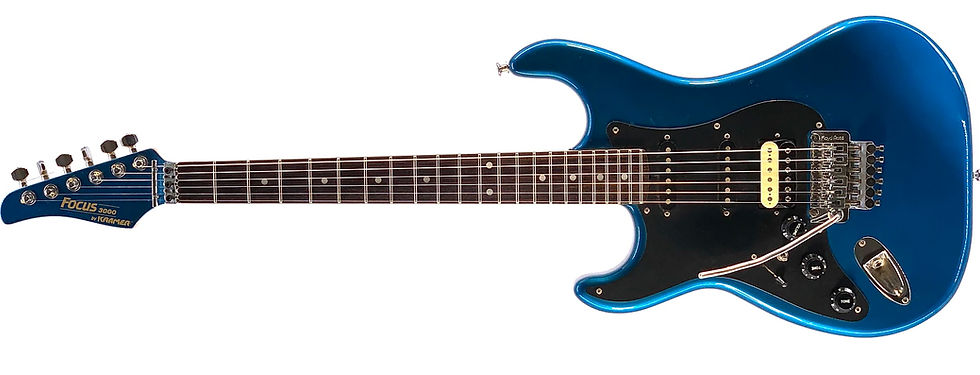
Left-handed examples from this era include this white 1983 Pacer Deluxe, this white 1984 Baretta, this pink 1985 Baretta, this pink 1985 Pacer, this blue 1986 Focus 3000 (pictured below), and this black 1986/1987 Focus 1000.
Floyd Rose today: The 100-Series
The modern double-locking Original Floyd Rose tremolo is designated the 100-Series and is almost unchanged from the original production model from 1983. The left-handed product code is FRT-100L.
The modern unit is made of high-quality hardened steel and the sustain block is made of nickel-plated brass. Saddles are CNC-machined hardened steel. A minor difference between the original Kramer-era units and the modern units is that the modern baseplate is a full 1mm thinner than the very first Schaller originals.
Note: Lefty versions used to be available in chrome, satin chrome, black, gold, black nickel, vintage copper, and satin pearl, but as of late 2025, black, black nickel, and vintage copper have so far been deleted as the Schaller versions become phased out.
Genuine 1984 FRT-5 1986 Kramer Pacer Deluxe Lefty Kramer Focus 1000 Original Floyd Rose FRT-5

Floyd Rose USA Series Original Tremolo
Years: 2025–present | Made in: USA | Status: Current
From 2025, Floyd Rose production has been brought back to the United States at their new state-of-the-art CNC and 3D printing facility in North Carolina. This was first announced at the March 2025 NAMM Show. By transitioning to in-house production, Floyd Rose gains direct oversight of every aspect of the manufacturing process, making it easier to implement design updates, fine-tune quality control, and ensure the highest production standards. In a 2025 statement President Andrew Papiccio said:
“Our process ensures tighter specifications and enhanced quality. By keeping production local, Floyd Rose maintains rigorous standards and supports American craftsmanship."
The 100-Series has always been Floyd Rose's flagship model, and the new USA-made unit is now designated the "USA Series Original Tremolo." It is made of high-quality hardened steel and the sustain block is made of nickel-plated brass. Saddles are precision CNC manufactured and now come in multiple radius options, eliminating the need for individual saddle shims. Alongside the traditional 12” radius, Floyd Rose Original Saddles are now available in 10”, 14”, 16”, and 17” radii. Locking nuts are now 3D printed. The base is still stamped "Floyd Rose Original" at the top.
Availability Note (2025): It is not clear if, or when, lefty versions of the USA Series are being produced. According to the Floyd Rose website, it appears that leftover stock of German products are still being sold off.
Original Floyd Rose 100 Series Lefty Original Floyd Rose 100 Series Lefty Original Floyd Rose 100 Series Lefty Original Floyd Rose 100 Series Lefty Original Floyd Rose 100 Series Lefty Original Floyd Rose 100 Series Lefty
Floyd Rose Original Non-Fine-Tuner Tremolo
Years: 1983–1986; 2015–present | Made in: Germany | Status: Current
Floyd Rose’s original tremolo system did not have fine tuners. It locked the strings at both the saddles and the nut. Once double-locked, the guitar could not be retuned without loosening the locking nut, retuning, and then retightening it.
The original system was initially built by Rose himself. Units made personally by Floyd carried a sticker on the sustain block reading “ROSE Tremolo Pat. #4,171,661 USA.” In the United States, the system was marketed officially as the “Floyd Rose Tremolo System.”
After partnering with Fernandes, Rose continued to build some units using a mixture of U.S.- and Japanese-made parts. Fernandes subsequently began supplying Japanese-made production units to Rose in the United States in early 1982. Fernandes designated the first production version the “FRT-1.” After a redesign of the saddles, the unit became the “FRT-3,” which was manufactured in Japan and supplied to Rose in the United States from the second half of 1982. Fernandes also fitted the FRT-3 to selected guitars in its Japanese domestic lineup. The Japanese-made FRT-3 was the first production model to be cast with "Floyd Rose" branding on the upper baseplate.
From late 1983 Schaller produced both the non-fine-tuner tremolo and new angled-tail fine-tuner tremolo. The German non-fine-tuner tremolo had "Floyd Rose" cast on the baseplate with "MADE IN GERMANY" on the underside, next to the tremolo arm hole. The Japanese equivalent was restricted to use in Japan only. (see detailed section below).
The German unit was used on the Kramer Striker Series from 1983 until 1986. There were left-handed models, such as this 1985 left handed Striker 300ST.
It was discontinued in 1986.
1986 Kramer catalog 1985 Kramer Striker Series 1985 Kramer Striker Series 1985 Left handed Kramer Striker with Non Fine Tuner Floyd Rose tremolo
After an absence of approximately 29 years from its 1986 discontinuation, Floyd Rose re-released this tremolo in 2015, driven by renewed interest, brought about by the influence of guitarists Guthrie Govan, Brad Gillis, and Yngwie Malmsteen. Today, it is called the "non fine tuner" tremolo. The reissued model is also made by Schaller, and although it was available left-handed during its original run, the reissue has never been available left-handed.
(Author's Note: With Floyd Rose's operations now based in the USA, it remains to be seen whether they will consider it feasible to produce a left-handed version of the reissued non-fine tuner model. As of 2026, there isn't one.)
Floyd Rose NFT Floyd Rose NFT Floyd Rose NFT Floyd Rose NFT
Floyd Rose II Single-Locking Tremolo
Years: 1986-1987 | Made in: Germany | Status: Obsolete
In 1986, Floyd Rose released the Floyd Rose II as a lower-cost tremolo with a die-cast zinc-alloy baseplate and a distinctive hammered-metal finish. This was a single locking tremolo bridge with fine tuners in which the ball ends of the strings did not need to be cut off. Instead, it used horizontal tubes which screwed into the saddle assemblies in place of conventional saddle-lock bolts. The strings were fed through the tubes, then through and over the saddles, with the ball ends held in place at the flanged entry points of the feeder tubes. This was a genuine Floyd Rose product made by Schaller in Germany for Korean-made Kramer guitars. Its design was very similar to that of the Fernandes Head Crasher FRT-6, which Fernandes had released approximately one year earlier.
It was cast with “Floyd Rose II” at the top and “Made in Germany by Schaller” at the bottom of the baseplate.
The Floyd Rose II was used on the 1986 - 1987 Kramer Striker Series made in Korea, while U.S-assembled Kramers and Japanese Focus Series continued to be built with the Original Floyd Rose double-locking tremolo. The Striker Series were available in left hand, such as this 1986 left-handed Kramer Striker 600ST.
1987 Kramer Import catalog 1987 Striker Series 1987 Striker Series left handed Kramer Striker 600S
Lefty single-locking Floyd Rose II Lefty single-locking Floyd Rose II Lefty single-locking Floyd Rose II
Floyd Rose II double-locking
Years: 1988 - 2000 | Made in: Germany | Status: Obsolete
From 1988, the Floyd Rose II name was reused for a lower-cost, die-cast zinc-alloy version of the double-locking Original Floyd Rose, also for Kramer import models. This unit was also made by Schaller in Germany. Its knife edges used replaceable inserts, and “Floyd Rose II” was cast into the top of the baseplate. Like the single-locking version, it had a distinctive hammered-metal finish. This was an official Floyd Rose product.
The double-locking Floyd Rose II first appeared on the Korean-made 1988-1989 Kramer Striker 100-Series. The Striker Series continued to be available in left hand. Examples include this white left-handed Kramer Striker ST100, this silver-grey left-handed Kramer Striker ST605, and this white 1988 left-handed Kramer Striker ST600.
The double-locking Floyd Rose II was also used on the 1989, Japan-only, “Kramer by ESP” TK Series. No left-handed versions are documented.
Left handed Floyd Rose II (double-locking) Left handed Kramer Striker S100 Left handed Floyd Rose II Floyd Rose and Floyd Rose II schematic
1989 was the final year of original Kramer production as the company went bankrupt in 1990.
After Fender became the distributor of Floyd Rose products in 1991, the Original Floyd Rose, Floyd Rose Pro, and Floyd Rose II were advertised in Fender catalogs. No left-handed guitars in Fender’s lineup were ever produced with Floyd Rose tremolos.
The Floyd Rose II appears to have been dropped from Fender catalogs around 2000.
1993 Fender Japan catalog 1993 Fender Japan catalog 1994 Fender Japan catalog
NOTE: New unbranded left-handed Floyd Rose II replacements can be bought here: Gaskell Guitars Retail | Reverb Australia
Floyd Rose II: OEM supply
Floyd Rose offered both the single-locking and double-locking Floyd Rose II tremolos as branded OEM versions, and these were adopted by Jackson, Carvin, Charvel, ESP, Hamer, Hohner, Gibson, Music Man, Peavey, Rockoon by Kawai, Washburn, among others for some of their production guitars through to the 1990s. These OEM models retained the hammered finish of the standard Floyd Rose II. Unlike the unbranded Floyd Rose II, OEM-branded versions carried the guitar brand’s name as well as a corresponding licensing statement (not present on the original.)
OEM units were embossed on the upper face of the baseplate with the guitar brand’s name and on the lower face with “Made in Germany by Schaller.” The tail was embossed with “Licensed Under Floyd Rose Patents” inside a border. The two U.S. patent numbers were cast into the sustain block.
Jackson-Charvel: For Jackson, the string-through Floyd Rose II was designated the JT-570, while the double-locking version was designated the JT-590. For Charvel, the corresponding double-locking unit was the FLC-202. These units were embossed with either “Jackson” or “Charvel” on the upper face of the baseplate. No left-handed guitars were produced with the JT-570. The JT-590 was used on the lefty Grover Jackson RR/L D-144. The identical FLC-202 was used on the 1989-1991 Japan-only, catalog-listed left-handed Charvel 475 Deluxe and the 1990-1991 Japan-only catalog-listed left-handed Charvel DK-095-SSHL.
Carvin switched from Kahler tremolos to the double locking OEM tremolo in 1990. It was listed in Carvin catalogs as the FC3 from 1990-1993. All Carvin guitars were available left-handed. OEM Floyd Rose-equipped Carvin guitars included the BC130 (1990 only), DC125, DC127, DC135, DC145, LS175 (1991 only), DC200, DC300, DC400, X220, and the long-running Ultra V. From 1994 Carvin switched to Wilkinson tremolos with the Original Floyd Rose as an option.
Hamer: The Schaller double-locking OEM unit was stamped "Hamer" on the opposite side of the "Made in Germany by Schaller" inscription and was used on many Hamer guitars. Left-handed examples include this red 1989 Elite Graphic Finish Hamer Custom Shop Californian Elite, this black 1990 Hamer USA Californian, this Transparent Cherry Red 1993 Hamer USA Diablo, and this Sea Foam Green 1993 Hamer E4TE Californian.
Lâg: French guitar brand Lâg used an OEM version of the Schaller double-locking Floyd Rose II for their guitars during the 1980s including this sunburst left-handed Lâg Roxane FR model.
Note: At that time, ESP, Gibson, Music Man, Peavey, and Washburn either did not produce left-handed guitars at all or did not offer left-handed models with the OEM Floyd Rose II. They did, however, use the tremolo on some right-handed guitars.

1993 left-handed Hamer USA Diablo with Schaller OEM Floyd Rose II Left handed Lag (France) with Schaller Floyd Rose OEM Hamer left handed 1990 Carvin catalog 1989 Charvel Japan catalog featuring left handed model with Schaller OEM Floyd Rose II Left handed Charvel 275 with Schaller OEM Floyd Rose II Jackson JT590 (Schaller Floyd Rose II OEM) Left handed Hamer
NOTE: Modern left-handed Floyd Rose II replacements can be bought here: Gaskell Guitars Retail | Reverb Australia
Floyd Rose 1000 Series Original Style Tremolo System
Years: ~2010 - present | Made in: Korea | Status: Current
Following the end of Floyd Rose’s licensed third-party manufacturing arrangements for the Original Floyd Rose, Rose resumed direct OEM supply to guitar brands. To distinguish the flagship German-made Original Floyd Rose from a lower-priced OEM version, Rose had the latter manufactured in Korea, beginning around 2010. It is as a genuine Floyd Rose product and was designated the "1000-Series" until 2020, after which it was renamed the “1000 Series Original Style Tremolo System.” The Korean-made version follows the same general design and material specifications as the German-made Original Floyd Rose, including a hardened-steel baseplate and saddles, with a brass sustain block. The only major difference is the country of manufacture.
In researching this material, I eventually identified Sung-il Hightech Co Ltd as one of Rose's OEM manufacturers, but AP International told me in 2025 that Sung-il had not worked with Floyd Rose "for a long time."
The product description on the Floyd Rose website historically stated:
"The 1000 Series Original is the Korean-made version of the Original Tremolo, made to the same specifications and materials, but is available only to guitar manufacturers and cannot be purchased aftermarket..."
The 1000 Series is simply stamped “Floyd Rose” on the baseplate, with one notable exception: EVH guitars fitted with the 1000 Series otherwise have “EVH Floyd Rose” stamped on the baseplate. This appears to have resulted from an arrangement between Floyd Rose and Eddie Van Halen during the development of his EVH/Fender guitars in the late 2000s. In a 2010 interview, Floyd Rose recalled that Eddie had “always wanted to have his name on it,” and said he eventually agreed to it “as a ‘thank you’ to him for his part.” The precise date of the arrangement is not publicly documented.
Examples include the current left-handed EVH Striped Series (Red with Black and White Stripes), EVH left handed 5150 Series Standard, EVH Wolfgang USA Left Hand, and EVH left-handed Wolfgang Special. This left-handed 2012 Fender EVH Wolfgang Standard is an early example. The EVH 1000 Series version was also advertised on the Floyd Rose website in both right-handed and left-handed versions alongside the 1000-Series Original during the 2010s.
1000 Series sustain blocks are stamped with the "FR" logo and website address. The lefty chrome version is the FRT-01000L, the black is the FRT-02000L and gold is the FRT-03000L.
1000-Series units were sometimes branded or co-branded. The co-branded format was "[Brand] by Floyd Rose" printed on the baseplate. An example is this blue 2016 left-handed ESP LTD MH-103 QM. In 2023 AP International told me that this was no longer the practice.
Floyd Rose 1000 Series Floyd Rose 1000 lefty EVH lefty Floyd Rose 1000 Lefty Jackson Soloist with Floyd Rose 1000 Lefty ESP LTD M-1000 with Floyd Rose 1000 EVH Wolfgang lefty Floyd Rose 1000 Schecter Lefty Floyd Rose 1000 Lefty Floyd Rose 1000
Floyd Rose Special Tremolo System
Years: 2008–present | Made in: Korea, China | Status: Current
The Floyd Rose Special was introduced in 2008, originally made in Korea exclusively for Floyd Rose. It was a strategic response to the flood of inexpensive Chinese Floyd Rose copies that began entering the market during the 2000s. It also undercut cheaper but still high-quality licensed Original-style alternatives such as the Takeuchi TRS-101 and Gotoh GE1996T. Takeuchi coincidentally went out of business two years later.
The Floyd Rose Special is exactly the same as the Korean-made OEM 1000 Series but uses zinc alloy saddles in place of steel and a zinc alloy sustain block in place of brass. It is branded "Floyd Rose Special" on the baseplate and has the "FR" logo on the block.
Both the Floyd Rose Special and Floyd Rose 1000 Series were formerly manufactured by Sung-il in Korea until around 2020, coincidentally the same year that both products disappeared from the Sung-il website. Current versions of the Special are made in China. These have a "W" stamped on the underside of the baseplate. Users have reported minor but noticeable differences in quality between the Korean and Chinese versions.
Unlike the 1000 Series, the Special is available to the public and can be purchased directly from AP International or from a reseller. Left-handed versions were not made available until 2020. The S1000L, S2000L, and S3000L models are the left-handed chrome, black, and gold versions, respectively.
The Special has increasingly become the more common choice for mid-level tremolo-equipped guitars and can even be found on some entry-level guitars.
AP International also offers guitar brands the option to co-brand it in the "[Brand] by Floyd Rose" format formerly reserved for the OEM-only 1000 Series. Jackson’s current left-handed JS32L Randy Rhoads V, is an example.
NOTE: From 2021, there was a left-handed 7-string Floyd Rose Special, model FRTSSS1000L, but as of 2025 the Floyd Rose website listed these as sold out. The 7-string lefty was available in chrome, black, black nickel, and gold. Left-handed examples include this Dean USA Limited Edition Rusty Cooley Signature RC7, this Schecter Jeff Loomis JL-7, this Sawtooth Americana Heritage HM724, and this Agile Interceptor Pro 725 EB DNC. Discontinued left-handed models include this Washburn PXSOLAR170CLH Ola Englund Parallaxe Solar 7-String.
Left-handed Floyd Rose Special Left-handed Floyd Rose Special Left-handed Floyd Rose Special Left-handed Floyd Rose Special Jackson co-branded left-handed Floyd Rose Special ESP-co-branded left-handed Floyd Rose Special Left-handed Floyd Rose Special Left-handed Floyd Rose Special
NOTE: Left-handed Floyd Rose Special alternatives can be bought here: Gaskell Guitars Retail | Reverb Australia
Floyd Rose 1500 Series
Years: ? | Status: Current
The 1500 Series Tremolo is an upgraded version of the OEM 1000 Series Tremolo (made in Korea) with stainless steel saddle screws and saddle lock bolts, and a Push-In tremolo arm. Like the 1000 Series, the 1500 Series is an OEM option available only to guitar manufacturers and is not available for aftermarket purchase. There are 6 and 7 string versions.
As an individual, you can upgrade your existing 1000 Series tremolo yourself with these parts to make it a 1500 Series:
Push-In Tremolo Arm
Stainless Steel saddle screws
Stainless Steel saddle lock bolts
Floyd Rose 1500 Series (Stainless Steel upgrades) Floyd Rose 1500 Series (Stainless Steel upgrades) Floyd Rose 1500 Series (Stainless Steel upgrades) Floyd Rose 1500 Series (Stainless Steel upgrades) Floyd Rose 1500 Series (Stainless Steel upgrades) Floyd Rose 1500 Series (Stainless Steel upgrades)
Fernandes 1981 - 1985 (Floyd Rose contract)
Fernandes Co. Ltd. of Japan was the original contracted supplier of Floyd Rose tremolos, supplying the prototypes and first production models starting in late 1981.
Fernandes was primarily a design, marketing, and distribution company, not a manufacturer itself. The company began in 1969 as Saito Musical Instruments Co., Ltd., marketing Fender-style guitars under the Fernandes brand and Gibson-style guitars under the Burny brand. In 1972, the company was renamed to Fernandes Co., Ltd. and established Osaka Fernandes Co., Ltd. as a separate legal entity to handle wholesale, distribution, and sales support. Fernandes Co., Ltd. served as the primary brand holder and product developer, focusing on design, artist licensing deals, and oversight of outsourced manufacturing, while Osaka Fernandes Co., Ltd. managed the supply chain for Fernandes electric guitars, basses, amplifiers, and effects pedals, handling domestic retail distribution and exports, such as those to the United States.
Fernandes relied on a network of OEM manufacturers to build its products. Fernandes guitars were originally built by Kawai Musical Instruments at its Shin'ya (新屋) factory in Hamamatsu, with supplementary production by Tokai during the 1970s and Matsumoku from December 1983 until December 1986. From the end of the 1980s, lower-end production shifted to Korea and Taiwan and by the 1990s Dyna had replaced Kawai as Fernandes’ primary Japanese manufacturing partner. Gotoh was its primary supplier of metal parts and pickups. Over time Fernandes expanded beyond guitars and began marketing electronics, replacement parts and accessories.
Up until 1983, Fernandes’ left-handed guitar policy was just a general statement that left-handed guitars were produced, but "not regularly." Left-handed guitars were available only by special order and cost 20% more than right-handed guitars, with a 3- to 4-month wait. Until 1982, catalogs noted only which models from the lineup could not be ordered.
All custom orders, including orders for left-handed guitars, went through Fernandes Repair Service. The division also facilitated post-purchase parts and colour changes, and from 1983, pre-purchase parts and colour changes, allowing all Fernandes customers some customization options beyond standard catalog specifications.
In addition, major retail chains and specialist guitar stores such as Ishibashi, Shimamura, Ikebe, Rock INN, and Musicland KEY could independently commission dealer-initiated “shop original” or “store‑exclusive” spot runs on an ad hoc basis, including left‑handed instruments. These were distinct from custom orders placed by individuals directly with Fernandes Repair Service. Usually, shop models had "Limited Edition" noted on the headstock or "Designed by..." added to the neck plate inscription, and sometimes an F-prefix serial number.
Floyd Rose FRT-1
Years: 1982 | Made in: Japan | Status: Superseded
After meeting at the 1981 NAMM Show, Floyd Rose contracted Fernandes to commercially produce his locking tremolo system, with production beginning in early 1982. Using Japanese factories, Fernandes supplied complete units and parts to Rose in the United States. It appeared in Fernandes' March 1982 catalog, on some Fernandes guitars, designated as the Floyd Rose FRT-1. It was also sold as a boxed kit and was available both right-handed and left-handed. The Japanese FRT-1s have a sticker on the sustain block that reads "Floyd Rose TREMOLO SYSTEM Pat. 4,171,661."
Left handed Floyd Rose FRT-1 (Fernandes Japan) Left handed Floyd Rose FRT-1 (Fernandes Japan) Left handed Floyd Rose FRT-1 (Fernandes Japan) Left handed Floyd Rose FRT-1 (Fernandes Japan) Left handed Floyd Rose FRT-1 (Fernandes Japan) Left handed Floyd Rose FRT-1 (Fernandes Japan) Left handed Floyd Rose FRT-1 (Fernandes Japan) Left handed Floyd Rose FRT-1 (Fernandes Japan)
In 1981, Fernandes launched its “The Revival” series, consisting of faithful replicas of traditional Fender models, and its “The Function” series, which was geared toward modern players and featured modernized body shapes, higher-output pickups, and flatter fretboards. Some new models from both series, as well as several models in the “Musician’s Limited Series,” received the new Floyd Rose Tremolo System.
“The Function” series models were built primarily by Kawai, with some additional production by Matsumoku beginning in December 1983. From 1984, Kawai-built instruments carried an L-prefix serial number on their neck plates. Matsumoku-built guitars carried seven-digit serial numbers, with the first number signifying the last digit of the year of manufacture, e.g., 6XXXXXX = 1986. Fernandes did use other OEMs such as Headway for some “Musician’s Limited Series” models.
According to the March 1982 catalog, the Floyd Rose FRT‑1 was featured on the following “The Function” models: FST-120H, FST‑90TH, FST‑70TH, FST‑70TH‑C, ST‑160 “Leopard”, ST‑130, EX‑145 (Explorer), and FV‑135 (Flying V) from the main lineup, as well as the ST‑135VH (Eddie Van Halen unofficial “Bumblebee” replica) and the LG‑135NS (Neal Schon official signature model) from the “Musician’s Limited Series”.
Select models of the Function Series for 1982 1982 The Function Series - with Floyd Rose FRT-1 tremolo 1982 Musician's Limited Series Fernandes 1982 policy on left-handed guitars
Floyd Rose FRT-1 on select 1982 models Floyd Rose FRT-1 on 1982 models Floyd Rose FRT-1 on select Musician's Series 1982 models
Fernandes left-handed availability for 1982: The 1982 companion Fernandes Specifications Catalog, also published in March, gave the policy but did not state anywhere which models could or could not be ordered left-handed.
③サウスポーギター 左用は常時生産していませんので器種によっては在庫のない場合があります。新たにオーダーする場合は、約3ヶ月〜4ヶ月の納期が基本となっています。価格は本体価格の20%アップとなっています。 <注>左用の場合は、パーツの関係上基準仕様のパーツとは異なる場合もありますので、あらかじめご了承ください。 | ③ Left‑handed Guitars Left‑handed guitars are not produced regularly, so some models may be out of stock. For new orders, the standard delivery time is about 3 to 4 months. The price is 20% higher than the instrument’s regular list price. (Note) For left-handed models, due to parts supply constraints, there may be cases where parts differ from the standard‑spec parts, so please understand this in advance. |
Floyd Rose FRT-3
Years: 1982–1985 | Made in: Japan | Status: Discontinued
The FRT-1 was only in production for six months. After a quick redesign of saddles, it was superseded by the new Floyd Rose FRT-3, made in Japan. The new version used two-piece saddles. The main body of each saddle was produced using lost-wax casting. The FRT-3 was the first production unit to feature “Floyd Rose” branding on the upper baseplate.
Fernandes continued to supply the new FRT-3 to Rose, where it was used exclusively on Kramer guitars in the United States, and on Fernandes guitars in Japan.
Original 1982/1982 Floyd Rose FRT-3 Original 1982/1982 Floyd Rose FRT-3 Original 1982/1982 Floyd Rose FRT-3 Original 1982/1982 Floyd Rose FRT-3 Original 1982/1982 Floyd Rose FRT-3 Original 1982/1982 Floyd Rose FRT-3
In Japan, the Floyd Rose FRT-3 appeared in Volume 1 of the 1983 Fernandes catalog, published in late 1982, as a genuine Floyd Rose product. It featured on the following “The Function” series superstrat models: FST-120H, FST-90H, FST-115, ST-160, ST-130, and ST-120, as well as on the FV-135 (Flying V) and EX-145 (Explorer) from the “Limited Series.” Artist models in the “Musician’s Limited Series” included the ST-105BG (Brad Gillis official signature model), ST-145SL (Steve Lukather official signature model), and ST-135VH (Eddie Van Halen unofficial “Bumblebee” replica).
As the official Floyd Rose distributor in Japan, Fernandes also sold the FRT-3 as an aftermarket upgrade. Examples of surviving guitars from brands other than Fernandes that were fitted with the FRT-3 include this (RH) 1982 Ibanez DT-300FR Destroyer II, this (RH) 1983 Aria Pro II ZZ Deluxe Flying V, and this (RH) 1983 Aria Pro II PE-R80.
In 1984, the Japanese Floyd Rose FRT-3 was featured on the following “The Function” series superstrat models: FST-115, FST-85, and FST-80; the BSV-90 (Flying V); and the EX-145 and EX-100 (Explorers) from the “Heavy Metal Version” series. Artist models in the “Musician’s Limited Series” included the ST-155BG (Brad Gillis official signature model), ST-105BG (Brad Gillis official signature model), ST-145SL (Steve Lukather official signature model), ML-120MJ (Mick Jones replica), and LG-135NS (Neal Schon official signature model).
According to the 1985 catalog, the FRT-3 was featured on the FST-75 “The Function” superstrat and the JS-100 (Randy Rhoads V) from the “Heavy Metal Version” series. Artist models in the “Musician’s Limited Series” included the ST-155BG (Brad Gillis official signature model), ST-120BG (Brad Gillis official signature model), ST-105BG (Brad Gillis official signature model), ST-145SL (Steve Lukather official signature model), JS-100VV (Vinnie Vincent unofficial replica), and the ML-120MJ (Mick Jones unofficial replica).
Japanese Floyd Rose FRT-4
Years: 1983 | Made in: Japan | Status: Superseded
Although it never made it past the prototype stage in the United States, the Floyd Rose FRT‑4 became an official production model in Japan. It appeared in the March 1983 Fernandes/Burny catalog as a genuine Floyd Rose product, alongside the Floyd Rose FRT-3.
The Floyd Rose FRT-4 was originally featured on the Fernandes FST-155 and FST-135 superstrats and the FV-135 Flying V. As a follow-up, Fernandes subsequently ran an advertisement in the June 1983 issue of Young Guitar magazine announcing the new Floyd Rose FRT-4 as a model upgrade for the ST-145SL Steve Lukather and ST-135VH Van Halen “The Musician’s Series” models. Floyd Rose tremolos were not fitted to any Burny models.
1983 Floyd Rose Tremolo System and Fernandes Head Banker 1983 FST-155 and FST-135 with Floyd Rose FRT-4 1983 FST-155 and FST-135 with Floyd Rose FRT-4 1983 magazine advertisement for the Fernandes FST-135 with Floyd Rose FRT-4 tremolo
The Floyd Rose FRT-4 product description on Page 3 of the 1983 Fernandes catalog stated:
●ファインチューナーを搭載!! フロイドローズFRT-4 チューニングを強力にサポートするストリングロックシステムに加え、弦をロックしたままチューニングの微調整を可能にしたのがファインチューナー付フロイドローズFRT-4だ!! チューニング後、上ナットおよびサドル部で弦をはさみ込み完全固定してチューニングを狂わなくしてしまう。しかし、弦がまだ新しい場合は弦自体の伸びでチューニングに多少のズレが生じる。そんな時、トレモロが付いていないギターでも弦が安定するまで調整するわけだが…このFRTの場合は、ある程度チューニングした後、弦を完全にロックして良いのだ。ロック後、万一、チューニングが狂っても上ナットをはずさずに、ファインチューナーノブを回すだけで正確なチューニングができる。 演奏前のクイック・チューニング、演奏中においては左手をネックにサポートしたまま右手でチューニングする離れ技もイージーにできるのだ。ライブにおいては、特に効力を発揮するはずだ。 | ● Super machine, Floyd Rose tremolo system, FRT‑4
In addition to its string-locking system, which provides strong support for tuning stability, the Floyd Rose FRT-4 is equipped with fine tuners that allow precise tuning adjustments even while the strings remain locked.
After tuning, the strings are clamped firmly at the locking nut and saddle, completely securing them and preventing the tuning from going out. However, when the strings are still new, their natural stretching can cause slight shifts in tuning. In such cases, even on a guitar without a tremolo, you would normally keep making adjustments until the strings stabilize... With the FRT-4, however, once you have tuned the strings to a certain degree, you can completely lock them. Even if the tuning goes out after locking, you can restore accurate tuning simply by turning the fine-tuner knobs, without removing the locking nut.
This makes quick tuning before playing easy, and even during a performance, you can easily perform the feat of supporting the neck with your left hand while tuning with your right. It should be particularly effective in live performances. |
The Japanese Floyd Rose FRT-4 was cast with "Floyd Rose" inside a rectangular border on the upper baseplate.
Japanese-made Floyd Rose FRT-4 Japanese-made Floyd Rose FRT-4 Japanese-made Floyd Rose FRT-4 Japanese-made Floyd Rose FRT-4 Japanese-made Floyd Rose FRT-4 Japanese-made Floyd Rose FRT-4 1983 Japanese Floyd Rose FRT-4 with vertical fine tuners 1983 Japanese Floyd Rose FRT-4 with vertical fine tuners
Here is a video by Youtube user mr. twistyneck examining several genuine Fernandes FRT-4 tremolos:
Fernandes left-handed availability for 1983: The left-handed ordering disclaimer on Page 38 of the 1983 Fernandes-Burny catalog was revised with new options for left-handed guitars, including some models from the lineup that would now be manufactured as production models. The catalog introduced a symbol system to distinguish the expanded ordering categories, shown in the “LH” column of the product list table.
③サウスポーギター
左用は常時生産していませんので器種によっては在庫のない場合があります。新たにオーダーする場合は、約3ヶ月~4ヶ月の納期が基本となっています。価格は本体価格の20%アップとなっています。 <注>左用の場合は、パーツの関係上基準仕様のパーツとは異なる場合もありますので、あらかじめご了承ください。
※印のものは生産していますが、常時生産しておりませんので、器種によっては在庫のない場合があります。その場合約3ヶ月~4ヶ月の納期が基本となっています。定価の20%アップになります。
―印のものはオーダーできません。 無印のもの はオーダーできますが、特注となり、納期は4ヶ月~5ヶ月が基本となります。定価の20%アップになります。 | ③ Left-Handed Guitars
Left‑handed guitars are not produced continuously, so some models may not be in stock. If a new order is placed, the standard delivery time is approximately three to four months. The price is 20% higher than the instrument’s base price. Note: Due to parts availability and compatibility, left-handed versions may sometimes use parts different from those specified for the standard model. Please understand this in advance.
Models marked with ※ are produced, but not continuously, so some models may be out of stock. In that case, the standard delivery time is approximately 3 to 4 months. The price is 20% higher than the instrument’s base price.
Models marked with ― cannot be ordered. Unmarked models can be ordered, but are treated as special orders. The standard delivery time is approximately 4 to 5 months. The price is 20% higher than the instrument’s base price. |
Models marked with ※ comprised seven in total, consisting of five Burny and two Fernandes models; however, none featured Floyd Rose systems.
Models marked with ― comprised 12 models.
Unmarked models with Floyd Rose systems that could therefore be special-ordered, subject to factory acceptance, were the FST-155 and FST-135, both with the Japanese FRT-4; and the FST-120H, FST-115, FST-90H, ST-120, ST-130, ST-160, FV-135, and EX-145, each with Floyd Rose FRT-3. Page 10 of the 1983 catalog even showed a picture of a left-handed blueburst EX-145.
Whether production models or special orders, all left-handed guitars were priced 20% higher than their right-handed equivalents, with an expected 3–4-month wait or longer depending on the model and parts availability.
Surviving examples of special-ordered left-handed guitars from 1983 are this EX-145 with FRT-3 and this FV-135, also with the Floyd Rose FRT-3.
1983 Left handed availability and ordering policy 1983 EX-145 and FV-135 available left-handed 1983 Fernandes FV-135 available left-handed by special order
ESP Magician
Years: 1983 | Made in: Japan | Status: Unauthorized Hansen clone
ESP introduced the Magician in 1983, shortly after the first Hansen Metalworks production run of Floyd Rose’s completed angled-tail design. It is a clone of the Hansen version with the same bent steel construction, curved tail, and oval cut-outs where the forks meet the tail. Its upper baseplate was etched “MAGICIAN.”
The Magician was neither a genuine Floyd Rose product nor an authorized copy. It is included here only as part of the early angled-tail design history and because it provided the immediate platform for the eventual Japanese Floyd Rose FRT-7, produced by Fernandes.
The Magician was announced in the "Something New" section of the July 1983 issue of Young Guitar magazine where it said:
ESP ファイン・チューナー付ロック・サドル・トレモロ MAGICIAN ¥50,000 フロイド・ローズ・タイプのトレモロ・ユニットにファイン・チューナーを取り付けたのがこのマジシャン。サドル部に設けられたファイン・チューナーにより、ミュート奏法の邪魔にならずに演奏でき、信頼性の高いプレイが可能である。このチューナーは何度でも正確なチューニングができ、チューニングの狂いを防ぐ効果もあるという優れもの。さらに、ステンレス製などの部品と特別加工されたプレートにより、音の伝導性が向上している | ESP Locking‑saddle tremolo with fine tuners MAGICIAN ¥50,000 The Magician is a Floyd‑Rose‑type tremolo unit fitted with fine tuners. Because the fine tuners are located at the saddle section, they do not interfere with palm‑muting and allow reliable, high‑precision playing. These tuners enable accurate tuning repeatedly and help prevent tuning drift. In addition, the use of stainless parts and specially processed plates improves sound transmission. |
In that publication it was advertised as fitted to the ESP SE-170, SE160, "Random Star" RS-223, and "Original Random Star" ORS-195. It was also an option on the ORS-223.
The Magician then appeared in ESP’s August 1983 export catalogue as a boxed kit or Custom Shop option:
ESP カスタム・ハードウェア:マジシャン・トレモロ・システム 世界初のフル・ファイン・チューナー・ロック・トレモロ。ダブル・ロッキングでピッチ・スタビリティを保証。ベンド・スチール・ベースプレート、T-ブロック・サドル、ナット/ワッシャー・アーム機構。ゴールド・フィニッシュオプションあり。対応モデル:Mirage SE-170, Navigator VHシリーズ。価格:¥50,000 (クローム)/¥55,000 (ゴールド)。 [Specs: Stud spacing 74mm; Knife-edge pivot; Compatible with locking nut.] | ESP Custom Hardware: Magician Tremolo System World's first full fine-tuner locking tremolo. Double-locking guarantees pitch stability. Bent steel baseplate, T-block saddles, nut/washer arm mechanism. Gold finish option available. Compatible models: Mirage SE-170, Navigator VH series. Price: ¥50,000 (chrome)/¥55,000 (gold). [Specs: Stud spacing 74mm; Knife-edge pivot; Compatible with locking nut.] |
The Magician disappeared after the September 1983 catalog. Here is very rare left-handed example of a 1983 ESP SE-260L.
1983 ESP Magician left handed 1983 ESP Magician left handed 1983 ESP Magician left handed 1983 ESP Magician left handed 1983 ESP Magician left handed 1983 Left-handed ESP SE-260L with Magician tremolo 1983 Left-handed ESP Magician tremolo 1983 Left-handed ESP Magician tremolo 1983 Left-handed ESP Magician tremolo
Schaller (imported) Floyd Rose FRT-5
Years: 1984 | Made in: Germany | Status: imported
Fernandes was well aware of the angled-tail development and had supplied parts for the prototypes, but appears not to have been informed of the production shift to Schaller. Fernandes apparently learned of the German version only after Schaller had begun manufacturing it. According to a former Fernandes employee who worked on the sales team, when they first saw the German angled‑tail production model at the end of 1983, there were comments about how “angular” and “industrial” it looked compared to the more curved and rounded appearance of the Japanese version that would likely have followed.
Upon receipt of the Schaller unit, the vertical fine‑tuner Floyd Rose FRT‑4 that Fernandes had been marketing throughout 1983 was discontinued, to be replaced by the imported German unit.
The new German product was advertised in Volume 1 of the 1984 Fernandes catalog, published in January, as the premier Floyd Rose FRT-5 and was featured on the Fernandes FST-155 and FST-135 superstrats, and the BSV-135 Flying V. The product information page and model descriptions for the FST-155 and FST-135 were both word-for-word repeats of the previous year’s product pages, with only "FRT-5" replacing "FRT-4" in the text, along with updated photographs.
Elsewhere in the catalog, the Floyd Rose FRT-3 was still standard on certain models. (Note: In 1984, the Eddie Van Halen "Musician's Series" model, previously advertised with the Floyd Rose FRT-4 in 1983, was discontinued due to legal disputes over the striping finish, and the Steve Lukather "Musician's Series" model, also previously advertised with the Floyd Rose FRT-4, reverted to the Floyd Rose FRT-3.)
Fernandes left-handed availability for 1984: The left-handed ordering disclaimer for 1984 remained the same as for 1983. The table in the catalog again used ※ to indicate models produced in periodic batch runs, — for ineligible models, and blanks for special orders.
Models marked with ※ comprised 10 models between the two brands. Of those, the FST-85 and FST-80 featured Floyd Rose tremolo systems, both with the Floyd Rose FRT-3.
Models marked with ―, and therefore unavailable for order, numbered 13, with only the FST-115 among the Floyd Rose models in that category.
Unmarked models were the FST-155 and FST-135, both with the Schaller Floyd Rose FRT-5; and the BSV‑90 and EX‑100, each with the Floyd Rose FRT-3.
1984 Floyd Rose and Fernandes tremolo range 1984 left-handed availability 1984 FST-155, FST-135 with Floyd Rose FRT-5 1984 FST-95 and FST-80 984 Fernandes BSV series 1984 Fernandes EX series
Japanese Floyd Rose FRT-7
Years: 1985 | Made in: Japan | Status: Superseded
For almost the entirety of 1984, Fernandes advertised the imported Schaller Floyd Rose FRT-5 as the primary Floyd Rose option, alongside its domestically produced Floyd Rose FRT-3.
Sometime during 1984, Fernandes utilized its OEM supply chain to formally produce the angled‑tail prototypes that had become the Hansen short‑run production model and the ESP “Magician”, as the domestic equivalent of the German FRT‑5. It was released officially as the “Floyd Rose FRT‑7” in Volume 1 of the 1985 Fernandes/Burny catalog, published in January. Of the two products, Fernandes featured only the FRT-7 on its own lineup for 1985 and sold the Schaller version solely as a kit for retrofit and aftermarket installations.
According to recollections made in 2012 by the same former Fernandes employee mentioned earlier:
...このFRT-5Shは、自社で生産しているものでなくいわば取次商品になるので、 当社としてはあまりおいしくありません。 そこで、FRT-5Shと同様のものを、国産で製作し販売を始めました。 これが国産FRT-5です。 そして翌1985年には、戦略的に価格を下げて展開を始めました。 FRT-5と区別する意味で、FRT-7と命名し、¥48,000で販売しました。飛躍的に販売が伸びました。 ちょっとの間 国産FRT-5という名前でした。 | ... this FRT-5Sh [Schaller] isn't something we manufacture ourselves. It’s basically an imported item we just distribute, so it isn't particularly profitable for us. Therefore, we began manufacturing and selling a domestically produced version similar to the FRT-5Sh. This became the domestic Japanese FRT-5. Then, in 1985, we strategically lowered the price and began rolling it out. To distinguish it from the FRT-5, we named it the FRT-7 and sold it for ¥48,000. Sales went through the roof. At first, it was called the domestically produced FRT-5. |
Both the German and Japanese versions were cast with "Floyd Rose" at the top of the baseplate. The Fernandes sustain blocks had a sticker that read "Floyd Rose TREMOLO SYSTEM PAT. 4,171,661." The Schaller units had "Made in Germany" embossed under its baseplate and a "Made in W. Germany" sticker on the sustain block. Some notable design differences are:
As with the Hansen Metalworks and ESP versions, the Fernandes version was made of bent steel. The German production version was cast.
The German version used imperial measurements. The Japanese version used metric measurements.
In common with the Hansen and ESP versions, the arches between where the forks meet the tail are oval on the Fernandes Floyd Rose FRT-7, whereas the arches are square on the Schaller Floyd Rose FRT-5.
The baseplate of the German version is more rectangular with harder right angles, and the tail has a straight bend. The baseplate of the Japanese version is more rounded, and its tail curves back as with the Hansen and ESP production models.
Japanese Floyd Rose FRT-7 (1985) Japanese Floyd Rose FRT-7 (1985) Japanese Floyd Rose FRT-7 (1985) Japanese Floyd Rose FRT-7 (1985)
According to the 1985 Fernandes catalogs, the pricing was listed as follows:
Colour | German FRT-5 (1985) | Japanese FRT-7 (1985) |
Chrome | ¥65,000 | ¥45,000 |
Gold | ¥68,000 | ¥47,000 |
Black | ¥69,000 | ¥47,000 |
FRT-7, FRT-2 Head Banker, FRT-6 Head Crasher 1985 Floyd Rose FRT-5 and FRT-3
The Floyd Rose FRT-7 was featured on the Fernandes FST-85, FST-90, and FST-55 superstrats, and the BSV-70 and BSV-90 Flying Vs from the main lineup, and the BSV-155J "Jimmy" from the Musician's Series.
Fernandes Left-handed availability for 1985: In the 1985 Fernandes-Burny catalogs, as noted on page 49, the ordering process for left-handed guitars and general ordering conditions was revised to limit the choices for custom ordering and to add a feasibility check dependent on new tooling and the customer's willingness to pay extra. Models that the factories wouldn't produce left-handed remained marked as unavailable.
③サウスポーギターについて ●印のもの ロット生産していますが、常時生産しておりませんので、器種によっては在庫のない場合があります。その場合は、約3ヶ月~4ヶ月の納期が必要となります。定価は、本体定価の20%アップになります。 ▲印のもの ロット生産していませんが、特注で受付できます。その場合納期は、約3ヶ月~4ヶ月以上の納期が必要となります。定価は、本体定価の20%アップになります。 ×印のもの は、オーダーを受付けていません。 無印のもののオーダーを受付けておりますが、新たな治具が必要となる場合がありますので納期及び料金は、器種によって異なりますのでご注文以前にご確認ください。 | ③ Regarding Left-Handed Guitars Models marked with ● are produced in batches but not continuously, so some models may be out of stock. In that case, a delivery time of approximately three to four months is required. The list price is 20% higher than the instrument’s regular list price. Models marked with ▲ are not produced in batches but can be accepted as special orders. In that case, a delivery time of approximately three to four months or longer will be required. The list price is 20% higher than the instrument’s regular list price. Models marked with × cannot be ordered. Unmarked models [column left blank] may also be ordered, but since new jigs may be required, delivery times and prices vary depending on the model, so please confirm these details before placing your order. |
There were no Floyd Rose-equipped models marked with ● for 1985.
Floyd Rose-equipped models marked with ▲ were the FST-75, with the Floyd Rose FRT-3, and the FST-85, FST-90, and BSV-90, with the Floyd Rose FRT-7.
Models marked with × comprised 23 models in Volume 1 of the catalog and 28 models in Volume 2.
Unmarked models from the lineup that could therefore be special-ordered, subject to factory acceptance, comprised 23 models in Volume 1 and 19 models in Volume 2. However, none of these were equipped with Floyd Rose systems.
Surviving left-handed examples include this black 1985 FST-85L (serial # L028880.)
Left handed availability for 1985 1985 FST-90 available left-handed 1985 FST-85 available left-handed 1985 Fernandes FST-85L with Floyd Rose FRT-7 1985 FST-75 available left-handed 1985 BSV-90 available left-handed
End of contract
Sometime in 1985, the contract between Fernandes and Floyd Rose ended, and Schaller thereafter became the exclusive manufacturer of both the non-fine tuner and fine-tuner Floyd Rose systems. Fernandes' response was to rebrand their product range as the "Head Crasher Tremolo System" and shift to a licensing arrangement. For the next decade, Fernandes continued to develop and manufacture their own range of tremolo bridges exclusively for the Japanese domestic market. For Fernandes' post-contract developments see: Part 3: Floyd Rose Tremolos for Left-Handed Guitars: Proprietary Versions
On April 26, 2023, the Osaka District Court issued a bankruptcy commencement order for Osaka Fernandes Co., Ltd. due to prolonged sales declines and insurmountable debts. This decision predated and ultimately accelerated the insolvency of Fernandes Co., Ltd., which cited the event as a tipping point for its own insolvency (filing in July 2024 with ¥730 million in liabilities). Fernandes Co., Ltd. closed its doors in July 2024. As of December 2025, Osaka Fernandes remains in bankruptcy proceedings, with no reported revival or asset sales. The Fernandes brand itself was partially acquired post-bankruptcy, but Osaka Fernandes' specific operations have ceased, marking the end of its role in the supply chain.
Author's note: To this day, the exact factories that Fernandes used to manufacture the original Floyd Rose tremolos have never been publicly confirmed. However, strong circumstantial evidence points to Gotoh as at least one. Gotoh was the major metal parts supplier for both Fernandes and Kawai, as well as ESP during the Floyd Rose-Fernandes contract period. Fernandes and Kawai pickups were made by Gotoh. Fernandes used and marketed Japanese-made Floyd Rose tremolos. ESP built Kramer guitars using these same Floyd Rose tremolos before Schaller took over as exclusive supplier. Kawai also used the Head Crasher and Body Crasher tremolos on some of its own guitars. It was ESP—not Fernandes—that first released the finalized angled-tail Floyd Rose design publicly in Japan (albeit an unauthorized replica of the first commercial version made by Hansen Metalworks in the United States.) This was several months before Schaller began production, and 16 months before Fernandes released the Hansen copy officially in Japan as the "domestic Floyd Rose FRT-5" and then as the genuine "Floyd Rose FRT-7" from January 1985. ESP picked it up again in 1988, this time unbranded, as the "KLK-I" for its "parts bin" Kramer Japan range. This timing coincided with Fernandes adopting its new range of Korean-made Floyd Rose style tremolos with horizontal fine tuners. There are no primary sources, and it all remains a mystery.
Ping Well 1987 - 2008
Ping Well Industrial Co. Ltd., located in Taiwan, was a supplementary producer of genuine Floyd Rose tremolos during the 2000s and was personally selected by Rose to manufacture his SpeedLoader tremolo system introduced in 2003.
The company also supplied licensed Floyd Rose tremolos as OEM products and produced proprietary models for multiple guitar brands. Ping Well also has a number of patents for guitar tuners and locking tuners.
Since 2020, Ping Well has owned and managed the TISONIX trademark, which is associated with titanium products. Under its TISONIX brand, Ping Well collaborated with Floyd Rose in the 2020s to produce an Original Floyd Rose tremolo 100% made entirely of titanium. Note: Geoffrey McCabe filed a trademark cancellation case against Ping Well in 2022. As with his prior litigation involving Floyd Rose and Ping Well in 2010 (McCabe v. Floyd Rose Guitars et al.), this case was unsuccessful, with Ping Well retaining the rights.
The following information is about Ping Well's genuine Floyd Rose products that were available left-handed.
For Ping Well's OEM production of licensed Floyd Rose systems that were also available left-handed, see: Part 2: Licensed Versions
For Ping Well's OEM production of proprietary systems for other brands, that were also available left-handed, see: Part 3: Proprietary Versions
The following genuine Floyd Rose products produced by Ping Well that have never been available left-handed are covered in Part 5: No-Names, Fakes, Unknowns, and Never Left-Handed
Titanium Floyd Rose Tremolo System
Floyd Rose SpeedLoader
Floyd Rose FRX Tremolo System
Fender Deluxe Locking Tremolo
Floyd Rose 1000 Series Pro Tremolo System
Genuine Floyd Rose Tremolo
Years: 2000s–2010s | Made in: Taiwan | Status: Discontinued
During the 2000s, Ping Well manufactured a double locking tremolo that was identical in every way to the German-made Original Floyd Rose but with a solid, "non-plated" brass sustain block and arm bushing. Apparently, it was produced under the direct supervision of Floyd Rose. There is very little publicly available information about this product.
This Ping Well unit was apparently the only product other than the German-made original that was permitted to be branded simply as "Floyd Rose." It had "Floyd Rose" laser-etched on the upper baseplate with the "PW" logo on the lower base. Since the beginning of licensed production in the 1980s, licensed third-party versions were distinguished from the genuine Original Floyd Rose by the absence of “Floyd Rose” branding and the presence of a visible licensing statement acknowledging Floyd Rose patents. Strangely, despite being branded "Floyd Rose," the tail of this Ping Well unit was laser-etched with "LICENSED UNDER FLOYD ROSE PATENTS" in white lettering. One side of the sustain block was cast with the block size and sometimes the '236 and '661 patent numbers, while the other side was cast with the "PW" logo. (Author's comment: because this product is Floyd Rose-branded yet has a licensing statement, it is not clear to me if this one should be considered a "genuine" or "licensed" product. I have defaulted to "genuine" because of the direct connection to Floyd Rose personally. Also, unless there is evidence, this may have never been available as a left-handed tremolo, which would actually put it in Part 5 of this series.)
It was used on the Gibson Les Paul Axcess Series, introduced in 2008. The unit supplied to Gibson had "Floyd Rose" in a cursive font on the baseplate. It was also available as an aftermarket kit through distributors such as Axcessories (www.axcessories.com) and was only US$30 less than an Original Floyd Rose. These kits could still be bought up to about 2016.
Note: Ping Well has not advertised Floyd Rose tremolos of any kind since its last-ever catalog in 2015.
Ping Well Genuine Floyd Rose Tremolo
Floyd Rose SpeedLoader Fixed Bridge
Years: 2003 - ? | Made in: Taiwan | Status: Discontinued
The Floyd Rose SpeedLoader Fixed Bridge is a flat-mount fixed bridge with fine tuners based on the SpeedLoader and released at the same time. Being fixed, it can be used as a right-handed or left-handed bridge. I've never seen one, but apparently, it can still be used with Fender bullet strings. It has "Floyd Rose" in cursive script embossed at the top of the baseplate, with "Fixed" embossed on the other side. "P.W" is embossed on the underside.
This bridge also came under scrutiny in the McCabe vs. Floyd Rose et al. case in 2010.
As of 2025, knockoffs are being sold on AliExpress and even state they are "made in Taiwan." The only way they are not counterfeits is if they are, in fact, leftover dead stock.
Floyd Rose Speedloader Fixed Bridge Floyd Rose Speedloader Fixed Bridge Floyd Rose Speedloader Fixed Bridge Floyd Rose Speedloader Fixed Bridge
Glossary of Terms
Batch-produced: See Lot runs
Custom order: Made-to-order units, often with long lead times or higher cost. With Japanese guitars this also refers to store-exclusive models initiated by a music store. Sop originals usually had "Limited Edition" on their headstocks or "Designed by..." or an F-serial on their neck plates.
Double-Locking: A system where the strings are clamped at two points: the bridge (via saddle blocks) and the nut (via a locking nut). This removes the tuning pegs from the equation during play.
Fine Tuners: The small, knurled screws on the back of the bridge used for precision tuning after the nut has been locked.
HSS: humbucker (bridge) + single-coil (middle) + single-coil (neck.)
HH: humbucker (bridge) + humbucker (neck)
Knife Edges: The two sharpened points on the baseplate that pivot against the mounting studs. This is the "friction point" of the system.
License stamp: “Licensed Under Floyd Rose Pats.” on a tremolo post-2008 does not indicate an active agreement — it’s legacy tooling or marketing.
Licensed Floyd Rose: A tremolo made by a third-party manufacturer with official permission by Floyd Rose .
Locking Nut: A nut consisting of three metal pads tightened by hex bolts. Lefty Note: Nut sizes (R2, R3, R4) are mirrored for lefties (L2, L3, L4). A right-handed nut cannot be used on a lefty neck.
Lot runs: Stock products manufactured only in periodic runs, not continuously.
N.O.S. (New Old Stock): Unused parts from discontinued production runs.
OEM (Original Equipment Manufacturer): A third-party manufacturer that produces parts for other brands.
OFR: Original Floyd Rose. Applies to the modern FRT100 Series currently made in the USA and formerly made in Germany. Historically also refers to the Japanese and German FRT-5.
Proprietary: A complete in-house design, or derivative design of a Floyd Rose product which may or may not also have been "licensed under Floyd Rose patents."
Radius: The curvature of the saddles. A Floyd Rose must match the fretboard radius (e.g., 12", 16") to ensure consistent string height.
SSS: single-coil (bridge) + single-coil (middle) + single-coil (neck)
Tremolo: A musical effect where the volume (amplitude) of a note is rapidly modulated, producing a pulsating or shuddering sound. It is distinct from vibrato, which otherwise affects pitch, not volume. Since 1954, this term has been technically misused to describe pitch-bending effects such as those produced by guitar vibrato systems. The error originates with Leo Fender.
Upcharge / Surcharge: An upcharge is an extra charge for an additional service or option, while a surcharge is an extra charge added to the standard cost, often for specific circumstances.
Vibrato: A musical effect where the pitch of a note is varied up and down, usually rapidly, creating a warbling or wavering sound. This expressive technique adds warmth and richness to music, commonly used by singers and instrumentalists.


Comments